

Our mission
America EDU is published by the Institute of Developmental Anthropology, which is responsible for the editorial standards, sourcing decisions, and corrections process described on this page. Questions about how we source what we publish can be sent to editorial@america.edu; corrections go to corrections@america.edu.
America EDU exists to make the process of researching U.S. colleges, degree programs, financial aid, and career outcomes less confusing. Higher education decisions involve some of the largest financial commitments a person makes outside of buying a home, yet the information needed to make a good decision is scattered across dozens of federal databases, individual college websites, accreditor directories, and state agencies, each with its own format and its own gaps. Our goal is to organize that information into a consistent structure — by state, by program, by degree level — and to be explicit about what is a verified fact, what is general guidance, and what you still need to confirm directly with an official source before acting on it. We built this site because we kept seeing the same pattern in college-planning advice: either a page was full of specific-sounding numbers with no visible source, or it was so vague and generic that it didn't actually help a reader make a decision. We try to sit in the narrower, more useful space between those two failure modes — specific where we have a verifiable source, and honestly general (with a pointer to where to get the specific answer) where we don't.

Friendly editorial photography gives long research pages a natural visual pause while the detailed data, sources, tables, and guidance stay central.
Education photo via UnsplashWhat America EDU is — and isn't
This site is an independent research and planning resource. We are not a college, we do not grant degrees, and we are not affiliated with any specific university, accreditor, or government agency named on this site. We do not process admissions applications or financial aid applications; where a page discusses the FAFSA, Pell Grants, or federal loans, we link to the official federal source (studentaid.gov) rather than collecting that information ourselves. Think of America EDU as a structured starting point for research — the equivalent of a knowledgeable friend who has read through the federal data and accreditor rules and organized it by topic — not as a replacement for a college's own admissions and financial aid offices, which hold the final and authoritative word on their own programs, costs, and deadlines. We also are not a government agency: studentaid.gov, the Department of Education, and state higher-education agencies are the authoritative sources for the rules we describe, and where our summary and an official source ever appear to disagree, the official source governs.
How we research and source content
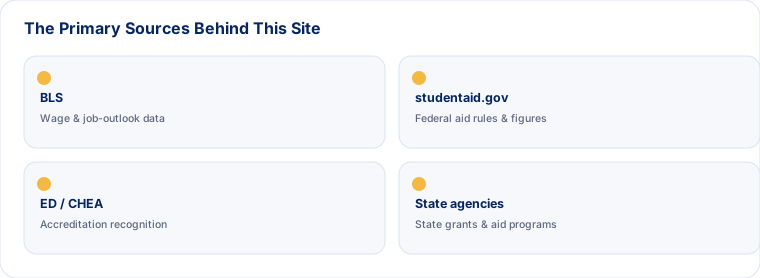
Where this site cites specific facts — wage and job-outlook data, financial aid program names and figures, accreditation bodies, degree requirements — we draw from primary sources: the U.S. Bureau of Labor Statistics Occupational Outlook Handbook for career and wage data, studentaid.gov and the Federal Student Aid Handbook for federal aid rules, the U.S. Department of Education's accreditation database and CHEA's directory for accreditor recognition, and each state's official higher-education agency for state-level grant and aid program names. General guidance sections — how to build a college shortlist, how to compare financial aid offers, how to write a scholarship essay — reflect widely accepted practices in college counseling rather than a single proprietary methodology, and we say so explicitly rather than presenting general advice as if it were a unique, closely guarded framework.
Because our state- and program-level pages describe a field or a state's higher-education landscape broadly rather than reviewing individual named colleges in detail, we do not claim to have independently verified every fact about every specific institution a reader might be considering. Instead, we tell you exactly which official source to check — the accreditor's own directory, the college's net price calculator, the state licensing board — for facts that are specific to one school and that change over time.
Editorial independence and advertising
This site is supported by advertising, including through the Google AdSense network. Advertising does not influence which programs, states, or fields are covered, how they are described, or any factual claim made on this site. Advertisements are visually distinguished from editorial content and are not written or selected by the same process used to research and write the surrounding article. We do not accept payment from colleges, universities, or education companies in exchange for favorable coverage, inclusion, or ranking placement, and we do not operate a "pay to be featured" model. Where a page includes a comparison framework or checklist rather than a ranked list of named institutions, that reflects a deliberate editorial choice: we do not have the kind of institution-specific, continuously verified outcomes data that would be required to responsibly rank individual colleges against each other, so we focus instead on giving you the evaluation criteria and pointing you to the primary sources (accreditor directories, IPEDS/College Scorecard, a college's own disclosures) needed to do that comparison for the specific schools you're considering.
Accuracy, updates, and corrections
Financial aid figures, loan limits, accreditor recognition status, and program requirements change, sometimes annually and sometimes with little advance notice. We date and review the figures on this site against primary sources on an ongoing basis, and every page that cites a specific number or program name includes a note pointing to the official source so you can independently confirm it is still current. If you find outdated or inaccurate information anywhere on this site, we want to know about it — see the contact section below. Corrections are prioritized by how directly they affect a reader's ability to make a sound decision: financial aid figures, accreditation facts, and licensure requirements are treated as highest priority.
How to use this site well
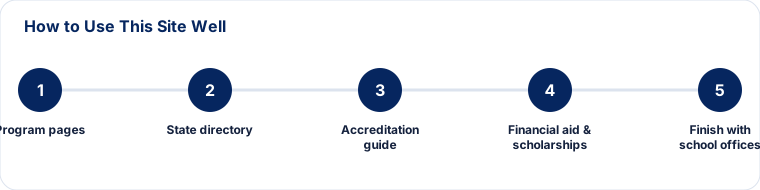
- Use the program pages to understand a field broadly — typical curriculum, accreditation to look for, and career data — before narrowing to specific schools.
- Use the state directory to understand what to research about programs in a given state — regional considerations, the state's major public university systems, and state-specific financial aid programs — rather than as a ranked or exhaustive list of every college in that state.
- Use the accreditation guide before applying anywhere, not after enrolling.
- Use the financial aid and scholarships guides together with each college's own net price calculator to build a realistic cost estimate specific to your situation.
- Treat every page here as a starting framework, and finish your research with the specific college's admissions office, financial aid office, and the relevant accreditor or licensing board.
Why the site is organized by state, program, and degree level
Most prospective students start their research with one of three questions: "What can I study?", "Where can I study it?", or "What level of degree do I need?" Rather than forcing every visitor through a single navigation path, this site is organized along all three axes at once. The Programs section is organized by field — the 50 subject areas covered here, from accounting to software engineering — each with a page explaining typical curriculum, the accreditation to look for, and BLS-sourced career data. The Universities section is organized by state, covering all 50 states and the District of Columbia, and is designed to help you understand what's specific to researching a given state: which public university systems anchor it, what state financial aid program to check, and regional considerations like cost of living and license reciprocity. The Degrees section is organized by credential level — certificate, associate, bachelor's, master's, and doctoral — explaining what each level generally involves, how long it typically takes, and when it satisfies a licensure requirement on its own versus when it's a stepping stone toward a further credential. Cross-referencing all three (a specific program, in a specific state, at a specific degree level) is the fastest way to narrow a broad field of interest into an actionable shortlist of schools to research directly, rather than starting from an unstructured web search and hoping to stumble onto the right combination of facts.
Our approach to plain-language writing
Financial aid rules, accreditation systems, and licensure pathways are written, in their original form, in dense regulatory and institutional language that is genuinely difficult to parse even for motivated readers. Federal handbooks run hundreds of pages, accreditor policy manuals are written for institutional compliance officers rather than 18-year-old applicants, and state licensing board regulations are often written in statutory language that assumes a legal background. We aim to translate that language into plain, direct explanations without oversimplifying to the point of inaccuracy — where a rule genuinely has exceptions or state-by-state variation, we say so rather than flattening it into a false universal statement, even when a simpler (but wrong) version would read more smoothly. If you find a page on this site that assumes background knowledge it doesn't explain, or that uses jargon without defining it, that's a gap we want to close; let us know through the contact page, and tell us specifically which term or step didn't make sense.
What this site does not cover
We do not currently publish individually researched profiles of every college and university in the United States, admissions-chance predictions, or a database of real-time tuition and acceptance-rate figures pulled directly from each institution. For that level of school-specific detail, the U.S. Department of Education's College Scorecard and each institution's own Common Data Set (published by most colleges) are the most current and authoritative free sources, and we link to them where relevant rather than duplicating that data imperfectly. We see our role as the layer above that data — helping you understand what the numbers mean, what questions to ask, and which official source has the answer — rather than attempting to replace primary sources with our own secondary compilation of school-specific statistics. As this site grows, we intend to add more direct links and citation paths to those primary sources on every page, rather than expanding into building a competing, harder-to-verify database of our own.
Frequently asked questions
Is America EDU a college or university?
No. America EDU does not grant degrees, enroll students, or process admissions or financial aid applications. We are an independent research and planning resource.
Do colleges pay to be included or ranked on this site?
No. We do not accept payment from colleges, universities, or education companies in exchange for coverage, inclusion, or favorable placement. The site is supported by display advertising, which is served independently of editorial content.
How current is the information on this site?
Pages that cite specific figures (financial aid amounts, loan limits, accreditor names) note the date the figure was last verified against a primary source. Because these figures change — sometimes annually — we recommend confirming any number that will affect a real decision directly at the primary source linked on that page.
Can I suggest a program, state, or topic you haven't covered yet?
Yes. Use the contact page to suggest additions; we prioritize gaps that affect the largest number of readers first.
Does this site offer personalized admissions or financial aid advice?
No. We provide general, structured research information. For advice specific to your situation, contact a college's admissions or financial aid office, a school counselor, or a qualified independent education consultant.
Contact and feedback
For corrections, questions, or feedback about this site's content, use the contact page linked in the site footer. We review submissions regularly and prioritize corrections that affect financial aid, accreditation, or licensure accuracy, since those are the categories most likely to cause real financial or academic harm if left wrong. General feedback on clarity, missing topics, or suggested additions is also welcome and helps shape what we build out next. Thank you for using America EDU as part of your research — we hope it saves you time and helps you ask better questions when you reach the colleges and agencies that hold the final answers.