

Why you need a framework, not just a gut feeling
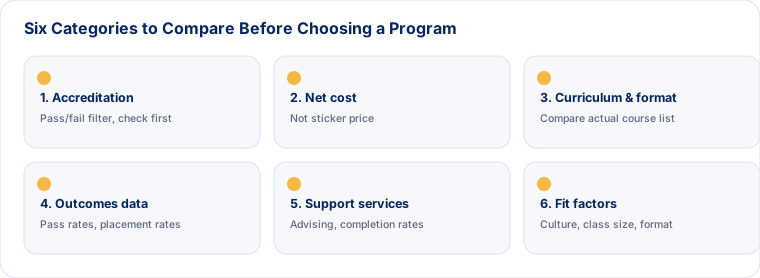
Comparing colleges or programs side by side is harder than it looks because the information that matters most — real net cost, accreditation status, actual outcomes — is rarely presented next to the information that is easiest to notice, like campus photos, rankings badges, and marketing copy. Two programs that look similar on a school's website can differ enormously in accreditation status, total cost after aid, and graduate outcomes. A structured comparison framework forces you to gather the same categories of information for every option, so you're comparing like against like rather than being swayed by whichever school made the more polished pitch, had the better-produced virtual tour, or simply reached out first with a persistent admissions counselor. This page walks through six categories worth comparing for any program, followed by a simple matrix you can build yourself and a worked example showing how the exercise can flip an initial, sticker-price-driven impression.

Friendly editorial photography gives long research pages a natural visual pause while the detailed data, sources, tables, and guidance stay central.
Education photo via UnsplashStep 1: Accreditation (a pass/fail filter)
Before comparing anything else, confirm institutional accreditation and, for regulated fields, programmatic accreditation for every option on your list. This is not a "nice to have" data point to weigh against others — a program lacking accreditation required for your intended licensure should generally be removed from consideration entirely, regardless of how strong it looks on other measures, because no amount of lower cost or convenient format offsets a credential that doesn't qualify you to practice. See our accreditation guide for how to verify this directly using the Department of Education's database and the relevant programmatic accreditor's own directory, rather than relying on a school's own claims. This single check, done before anything else, often narrows a long list down to a shorter one in a matter of minutes.
Step 2: Net cost, not sticker price
Published tuition tells you almost nothing about what you will actually pay. Use each school's net price calculator (federally required, usually linked from the financial aid page) to get a personalized estimate, and once you have actual admission and aid offers, compare net price — total cost of attendance minus grants and scholarships — rather than comparing tuition sticker prices or total aid dollar amounts, which can make a loan-heavy package look artificially competitive against a grant-heavy one. Multiply net price by the realistic number of years to completion (not just the standard published program length, since transfer credit loss and part-time enrollment both commonly extend it), and factor in whether a program has fixed or rising tuition for returning students, since some schools guarantee a flat rate for all four years and others increase tuition annually, which changes the real multi-year total in ways a single year's net price figure won't show.
Step 3: Curriculum and format
Look at the actual required course list, not just the program's marketing description, and compare it against the core coursework typical of the field (each program page on this site lists common core courses as a reference point). Ask specifically about format flexibility — fully online, hybrid, or in-person; synchronous (live, scheduled) versus asynchronous (self-paced) delivery for online components; and whether required in-person elements exist (labs, clinicals, practicums, capstones) that could affect a student who needs to work while studying. For fields requiring supervised experience — nursing clinicals, social work practicums, teaching student-teaching placements, engineering co-ops — ask directly how placements are arranged and whether the program guarantees a placement or leaves students responsible for securing their own, which is a meaningful practical difference.
Step 4: Outcomes data
For fields with a licensing exam, ask for the program's most recent exam pass rate (nursing NCLEX pass rates, for example, are publicly reported by state boards of nursing and are a standard, comparable metric across nursing programs). For fields without a licensing exam, ask about graduation rates, and where available, post-graduation employment or continuing-education rates, sourced from the college's own reporting or from the U.S. Department of Education's College Scorecard, which publishes standardized, comparable outcomes data across most degree-granting institutions. Be skeptical of outcomes statistics presented without a clear source, sample size, or time frame — "90% of our graduates find jobs in the field" is a much weaker claim without knowing over what period, out of how many graduates, and using what definition of "in the field." Ask the admissions or program office directly for the underlying methodology if a statistic is central to your decision, and treat a refusal or vague non-answer as meaningful information in itself.
Step 5: Support services and completion rates
A program's overall completion rate — the share of students who actually finish, not just the share who are satisfied with the parts they completed — is one of the most underused comparison metrics, and it is publicly available through College Scorecard for most institutions. Low completion rates can signal weak academic or financial support, a poor fit between the student population and the program's format, or both. Ask specifically about academic advising structure (dedicated advisors versus general staff), tutoring and writing center availability, mental health and disability support services, and, for online programs, technical support hours and whether coursework accommodates different time zones if the student population is geographically spread out.
Step 6: Fit factors that are still real
None of the above should crowd out genuine fit considerations — class size and teaching style, campus or program culture, extracurricular and professional community opportunities, and simple personal preference about environment. These factors are harder to quantify but influence whether a student actually completes a program and engages with it well, which in turn affects nearly every outcome metric above. The goal of a comparison framework is not to remove judgment from the decision, but to make sure judgment is applied on top of accurate information rather than in place of it — a student who loves a campus for legitimate reasons should still know its real net price and accreditation status before signing on.
Building a decision matrix
A simple way to compare multiple options consistently: list every school or program you're considering as a column, and the categories above as rows — accreditation status (pass/fail), estimated net price per year, total cost to completion, format and schedule fit, licensure/certification pass rate or completion rate, and support services available. Fill in each cell with a specific, sourced answer rather than a general impression, and leave a cell blank rather than guessing if you haven't yet confirmed the answer directly with the school. This turns an overwhelming, emotionally loaded decision into a smaller number of concrete, comparable facts, and it also creates a written record of exactly what you still need to verify before committing. A shared spreadsheet is useful here too, particularly for families making the decision together, since it keeps everyone working from the same verified numbers instead of relying on memory or secondhand summaries of a phone call with an admissions office.
A worked example
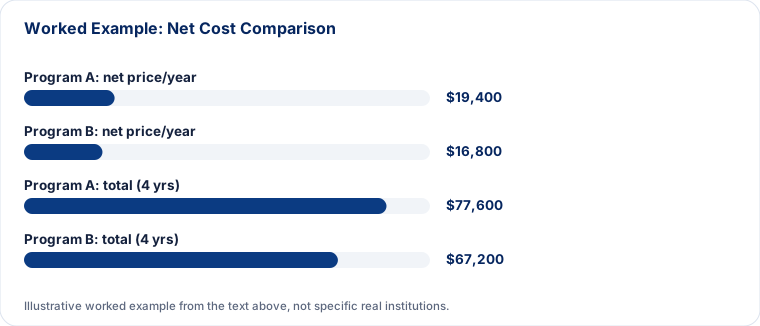
Consider a student comparing two nursing programs. Program A advertises a lower published tuition and a well-known campus, while Program B has a higher sticker price but offers a larger institutional grant. Filling in the matrix: both are CCNE-accredited (pass on the accreditation filter). Program A's net price, after aid, turns out to be $19,400 per year across four years ($77,600 total); Program B's net price is $16,800 per year across four years ($67,200 total) once the institutional grant is applied — the opposite of what the sticker prices alone suggested. Program A's most recent first-time NCLEX-RN pass rate was 91%; Program B's was 96%. Program A guarantees clinical placements through partner hospitals; Program B requires students to help arrange their own, with support from an advisor. On paper, Program B now looks stronger on cost and licensure outcomes, while Program A looks stronger on placement support — a genuine tradeoff rather than an obvious winner, and exactly the kind of nuance that sticker price and campus reputation alone would have hidden.
| Category | Program A | Program B |
|---|---|---|
| Accreditation (CCNE/ACEN) | Pass | Pass |
| Net price per year | $19,400 | $16,800 |
| Total net cost (4 yrs) | $77,600 | $67,200 |
| First-time NCLEX-RN pass rate | 91% | 96% |
| Clinical placement | Guaranteed via partner hospitals | Student-arranged with advisor support |
This kind of table, filled in with verified figures rather than assumptions, is the actual deliverable of a comparison process — not a single "best school" conclusion, but a clear record of exactly where the real tradeoffs are.
Using this site's tools alongside your own research
The program and state pages on this site are designed to feed directly into this framework: each program page lists the programmatic accreditor to check first, typical core coursework to compare against a specific school's curriculum, and BLS-sourced career data to sanity-check outcomes claims a school might make. Each state page names the state's primary financial aid program and major public university systems as a starting point for researching in-state options. Neither replaces contacting each specific school directly, but both can save time by telling you which questions to ask and which official sources to check before you do, so the calls and emails you do make are more targeted and get you a usable answer faster.
Red flags across every category
- Vague or evasive answers about accreditation, cost, or outcomes when asked directly.
- High-pressure enrollment deadlines disconnected from an actual academic term start date.
- Outcomes statistics with no source, sample size, or time period attached.
- A net price calculator that is missing, broken, or gives wildly inconsistent results between visits.
- Reluctance to connect you with current students or recent graduates for an honest perspective.
- Marketing materials that lean heavily on rankings or awards without naming the organization or methodology behind them.
Frequently asked questions
How many schools should I seriously compare?
There's no fixed number, but building a full comparison matrix for three to six realistic options is usually enough to surface meaningful differences without becoming unmanageable. Fewer than that risks missing a genuinely better option; many more than that usually adds diminishing returns for the extra research time required.
Should rankings factor into the comparison at all?
Rankings can be one input, but most published college rankings weight factors (selectivity, reputation surveys, endowment size) that don't correlate strongly with outcomes for a specific student in a specific program. Treat a ranking as a conversation starter, not a substitute for the categories above.
What if two schools look identical on every measured category?
That's a reasonable outcome, and it means the fit factors — culture, format preference, personal circumstances — are the legitimate deciding factor, since the objective comparison didn't produce a clear winner.
Where can I find standardized outcomes data across schools?
The U.S. Department of Education's College Scorecard (collegescorecard.ed.gov) publishes standardized cost, debt, and earnings data for most degree-granting institutions, and is a useful cross-check against a school's own self-reported statistics.
Is it worth comparing programs I'm not sure I'll be admitted to?
Generally yes, at least in an early research phase — knowing the comparison in advance helps you decide where to apply in the first place, and most of the data needed (accreditation, published net price ranges, licensure pass rates) is available before an admission decision.
How do I compare programs with very different formats, like online versus in-person?
Use the same categories, but pay special attention to format-specific factors within each: for online programs, technical support and asynchronous flexibility; for in-person programs, campus resources and commute or relocation costs. Total net cost and accreditation still apply equally to both.