

Why location is a financial decision, not just a lifestyle one
Where you attend college affects far more than climate and campus culture. It changes your tuition rate at public institutions, your access to state-specific financial aid, your cost of living for four or more years, the strength of the local job market in your field, and, for licensed professions, how easily your credential transfers if you later move. Prospective students often start location research with subjective questions — is the campus far from home, is the weather appealing, do I know anyone there — and only discover the financial and regulatory implications after enrolling, sometimes after a tuition bill or a licensure application makes the consequences unavoidable. This page walks through the location-related factors that have real dollar and career consequences, using the state pages on this site as a starting reference point for state-specific research.

Friendly editorial photography gives long research pages a natural visual pause while the detailed data, sources, tables, and guidance stay central.
Education photo via UnsplashIn-state vs. out-of-state tuition and how residency is determined
Public colleges and universities charge dramatically different tuition to in-state and out-of-state students, often a difference of two to three times the price for the same degree. Establishing residency for tuition purposes is governed by each state (and often by each public university system within a state) and is generally based on a combination of factors: length of continuous physical presence in the state (commonly 12 months prior to enrollment), intent to remain in the state independent of school attendance (demonstrated through a driver's license, voter registration, state tax filings, and employment), and financial independence from an out-of-state parent in some cases. Simply attending school in a state, or having a relative there, is usually not sufficient on its own to qualify for in-state tuition. Rules vary enough by state and by institution that if in-state tuition is central to your financial plan, contacting the registrar's office directly to review the specific requirements before enrolling is worth the time. Some states also offer a reduced or waived non-resident rate for military families stationed in-state, veterans, or students who graduated from an in-state high school even without a full year of independent residency — exceptions that are easy to miss if you assume the standard rule applies uniformly.
Regional tuition exchange programs
Several multi-state compacts let students pay reduced, non-resident tuition (typically 150% of in-state tuition rather than full out-of-state rates) at participating public colleges outside their home state, for specific majors or under specific conditions set by each receiving institution. The major regional exchanges are the Western Undergraduate Exchange (WUE), covering Western states through the Western Interstate Commission for Higher Education; the Midwest Student Exchange Program (MSEP), covering Midwest states; the New England Board of Higher Education's Regional Student Program (NEBHE RSP), covering the six New England states; and the Academic Common Market, covering Southern states through the Southern Regional Education Board (SREB), which is generally limited to majors not offered by a student's home-state public institutions. Not every public college in a member state participates, and not every major at a participating college is covered, so confirm current participation and eligibility directly with the receiving institution and the applicable regional compact before counting on the discount.
State authorization for online programs
Online programs are not automatically available to residents of every state. Under federal rules, an institution offering distance education generally must be authorized to operate in the state where the enrolled student resides. Most states and most accredited institutions participate in the National Council for State Authorization Reciprocity Agreements (NC-SARA), a voluntary reciprocity framework that streamlines this authorization across member states, but a small number of programs — particularly those leading to a professional license, such as teaching, nursing, counseling, and social work — often require separate state-specific approval regardless of NC-SARA membership, because licensure requirements are set independently by each state's licensing board. Before enrolling in an online program, especially one leading to licensure, confirm directly with the program that it is authorized to enroll students from your specific state and that its curriculum satisfies your state's licensure requirements, not just general accreditation.
Licensure portability across state lines
For regulated professions — nursing, teaching, law, accounting (CPA), social work, counseling, and several engineering roles — earning a license in one state does not automatically grant the right to practice in another. Some fields have interstate compacts that ease this: the Nurse Licensure Compact (NLC) allows a multistate license for registered nurses to practice in other compact-member states without a separate license in each; a similar Interstate Teacher Mobility Compact and Counseling Compact have expanded in recent years, though state participation is not universal and continues to change. Other fields rely on "licensure by endorsement," where a state licensing board reviews and approves an out-of-state license without requiring the full original exam process, but requirements (additional coursework, jurisprudence exams, background checks) vary by state and by board. If you expect to move states after graduation, or are studying in one state intending to practice in another, research the destination state's licensure reciprocity rules for your specific field before assuming your credential will transfer automatically.
Cost of living and total cost of attendance
Published tuition is only part of the cost of attendance; housing, food, transportation, and personal expenses vary enormously by region and can equal or exceed tuition itself, particularly in major metro areas. A college with lower tuition in a high-cost city can end up more expensive in total than a higher-tuition college in a lower-cost region, especially for students living off campus. Each college's cost of attendance figure, published alongside its net price calculator, is required by federal law to include a living-expense estimate for the local area, which is a more useful comparison point than tuition alone. Students planning to work part-time to help cover living costs should also research the local minimum wage and typical part-time wages in college towns versus major metro areas, since the tradeoff between earning potential and cost of living does not move in a consistent direction across every state. A useful check is to compare a college's published cost of attendance against median rent and grocery costs in its specific city or town, rather than relying on statewide averages, since costs inside a single state can vary as much between a college town and its state's largest city as they do between two different states entirely.
Local job markets and internship access
For fields where in-person internships, clinical placements, or early networking matter for job placement — business, healthcare, engineering, media, government, and technology are common examples — attending school in or near a strong regional job market for that field can meaningfully affect post-graduation outcomes, independent of the specific college's ranking. A student pursuing finance may benefit from proximity to a major financial center; a student pursuing government or international relations may benefit from proximity to a state capital or Washington, D.C.; a student pursuing healthcare may benefit from a region with multiple major hospital systems offering clinical placement capacity. This is a real, if sometimes underweighted, factor in comparing otherwise similar programs in different states, and it is worth researching using state-level BLS employment data for your specific field before finalizing a shortlist, alongside a direct question to each program's career services office about where recent graduates in your intended field actually ended up working.
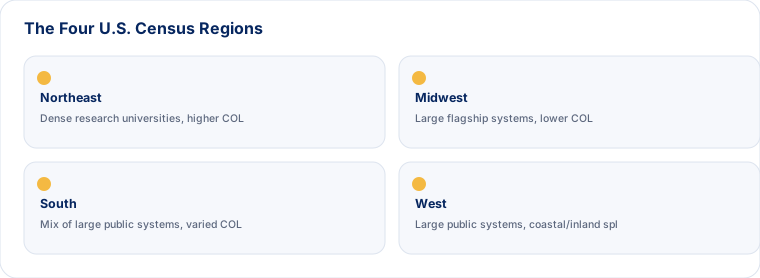
A quick reference to the four census regions
This site groups states into the four standard U.S. Census Bureau regions — Northeast, Midwest, South, and West — because several of the factors above (regional tuition exchanges, typical cost of living, common state grant structures) cluster along roughly these lines, even though every state still sets its own specific rules. The Northeast includes states such as New York, Massachusetts, and Pennsylvania, generally featuring a high concentration of both public and private research universities and higher average cost of living in its major metro areas. The Midwest includes states such as Illinois, Ohio, and Michigan, generally featuring large flagship public university systems and, outside major metro areas, a lower cost of living than the coasts. The South includes states such as Texas, Florida, Georgia, and Virginia, featuring a mix of large public systems and a broad range of cost-of-living environments from major metros to smaller cities. The West includes states such as California, Washington, and Colorado, featuring some of the country's largest public university systems (notably the University of California and California State University systems) alongside significant cost-of-living variation between coastal metro areas and inland regions. Use this only as a rough starting orientation — the state-by-state pages on this site are the more useful level of detail for actual planning.
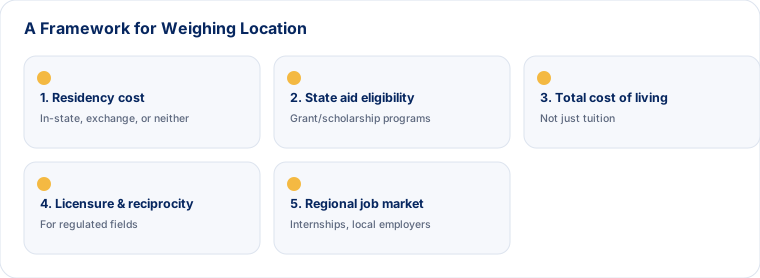
A framework for weighing location
- Residency cost. Would you qualify for in-state tuition, a regional exchange rate, or neither?
- State aid eligibility. Does the state offer a grant or scholarship program you might qualify for (see each state page on this site for its primary program)?
- Total cost of living, not just tuition, using each college's published cost of attendance.
- Licensure and reciprocity, if you're entering a regulated field and might practice in a different state later.
- Regional job market strength in your specific field, particularly for fields that rely heavily on local internships and employer networks.
Weigh these factors against the subjective ones — campus culture, distance from family, climate, personal preference — rather than treating either category as automatically decisive. The right answer is different for a student choosing between two in-state options with similar cost and a student weighing an out-of-state program with a strong regional job market against a cheaper in-state alternative in a weaker one.
Frequently asked questions
Can I become an in-state resident just by attending school in a state?
Generally no. Most states require demonstrated intent to remain in the state independent of school attendance, plus a minimum residency period, and simply enrolling as a student does not satisfy that on its own.
Do regional tuition exchange programs cover every major?
No. Programs like WUE, MSEP, and the Academic Common Market are typically limited to specific majors or specific participating institutions, and coverage changes year to year, so confirm current terms directly with the receiving school.
Is an online degree accepted the same way regardless of what state I live in?
The degree and its institutional accreditation are accepted the same way, but state-specific authorization to enroll and, for licensure-track programs, state-specific licensure requirements can still apply. Confirm both before enrolling if you're taking an online program from a school based in a different state than where you live.
Where can I find state-specific higher-education agency contact information?
Each state page on this site names the primary state grant program and administering agency as a starting point; search that agency's name directly for its official website and contact information.
Does moving out of state after graduation affect my student loans?
Federal student loans are not tied to a specific state and follow you regardless of where you live or work afterward. State-specific aid programs, by contrast, sometimes include service or residency conditions (for example, a requirement to work in-state for a period after graduation); review the terms of any state-specific grant or scholarship for conditions like this before accepting it.
Is it cheaper to live on campus or off campus?
It depends heavily on the local market. On-campus housing often bundles utilities and meal plans into a predictable flat cost, while off-campus housing costs vary with the local rental market and require budgeting separately for utilities, groceries, and transportation. Compare both using the college's published cost of attendance as a baseline, then adjust for your specific housing plan.
