

Types of scholarships
A scholarship is money for education that does not have to be repaid, awarded on some criterion other than pure financial need — though many scholarships combine merit and need. Broadly, scholarships fall into a few categories, and a realistic strategy usually pursues several at once rather than betting everything on one large national award. This page covers where scholarship money actually comes from, how to find awards with realistic odds of winning, how to write an application that stands out, and how to avoid the fee-based scams that specifically target students and families searching for aid.
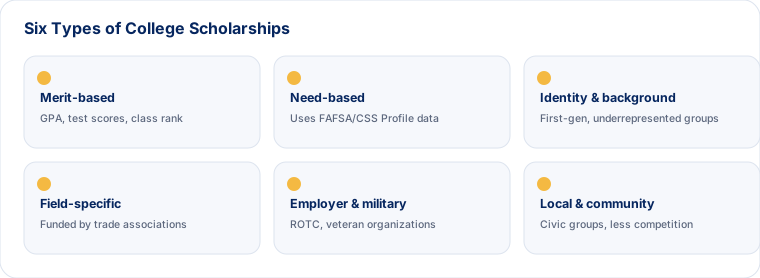
- Merit-based scholarships reward academic achievement (GPA, test scores, class rank), and are offered both by colleges directly and by outside organizations.
- Need-based scholarships are awarded using financial information, often the same FAFSA or CSS Profile data used for grants.
- Identity- and background-based scholarships target first-generation students, specific racial or ethnic communities, women in fields where they are underrepresented, LGBTQ+ students, students with disabilities, or students from a particular state or region.
- Field- or major-specific scholarships are funded by professional associations, employers, or foundations tied to a specific career path (see the field-specific section below).
- Employer and military-affiliated scholarships come from a parent's employer, a student's own employer, ROTC programs, or veteran-service organizations.
- Local and community scholarships are offered by local businesses, civic organizations (Rotary, Elks, Kiwanis), religious congregations, and community foundations — often smaller in dollar amount but far less competitive than national awards, because far fewer students apply.

Friendly editorial photography gives long research pages a natural visual pause while the detailed data, sources, tables, and guidance stay central.
Education photo via UnsplashWhere to actually find them
The single highest-yield source for most students is the financial aid office of each college they are considering — institutional scholarships (funded by the college itself) typically have far less competition than national databases because the applicant pool is limited to students already applying to that school. After that, useful sources include:
- Your high school counseling office, which often keeps a running list of local and regional scholarships specific to your area.
- Free national scholarship search databases (such as the College Board's BigFuture, Fastweb, and Scholarships.com) — legitimate services never charge a fee to search or apply.
- Professional and trade associations connected to your intended field (see below).
- Community foundations in your city or county, which frequently administer dozens of small, locally funded scholarships in one application.
- Your parent's or your own employer's HR department, which may offer a dependent or employee scholarship program.
- Religious congregations and cultural or civic organizations you or your family already belong to, which sometimes fund small scholarships that never appear in national databases.
Field- and major-specific scholarships
Professional associations tied to specific careers often fund scholarships for students pursuing that field, and these are consistently under-applied-for relative to general national scholarships. A student pursuing accounting, for example, can look to state CPA society scholarships; a nursing student to the American Association of Colleges of Nursing or state nursing association; an engineering student to the Society of Women Engineers or National Society of Professional Engineers; a social work student to the National Association of Social Workers' state chapters. The program pages on this site list the professional and accrediting bodies relevant to each of the 50 fields covered here as a starting point for identifying which associations to search for scholarship programs.
How to build a strong application
Scholarship committees, especially for smaller local awards, often read hundreds of similar applications. A few practices consistently separate competitive applications from forgettable ones:
- Answer the actual prompt. Generic essays reused across every application are usually obvious to reviewers; tailor at least the opening and closing to the specific organization and its stated values.
- Be specific, not just positive. "I want to help people" is weaker than a concrete story about a specific experience that shaped your interest in a field.
- Ask for recommendation letters early and give recommenders your resume and a note about what the scholarship is looking for.
- Proofread for the basics — word counts, formatting requirements, and required attachments are often used as an easy first-round filter.
- Apply broadly to smaller, local awards rather than only large national ones; the return on time invested is usually higher because competition is lower.
Scholarships for specific populations
Several groups of students have scholarship pathways that are easy to overlook because they are not listed in general databases. First-generation college students — those whose parents did not complete a four-year degree — qualify for a large number of foundation and college-specific scholarships explicitly reserved for them; the college's TRIO/Student Support Services office, where one exists, is often the best single point of contact. Students with disabilities can look to disability-specific foundations as well as general scholarship databases with disability-status filters, and should also ask about vocational rehabilitation funding through their state's VR agency, which is separate from scholarships but can be combined with them. Veterans and military dependents have scholarship programs through veteran-service organizations (the American Legion, VFW, and others) in addition to GI Bill benefits. International students face a smaller scholarship pool since most U.S. federal and state aid is restricted to citizens and eligible noncitizens, but many colleges offer merit scholarships specifically for international applicants, and some professional associations and foreign-government programs fund students studying particular fields in the U.S. Students who are the first in their family to pursue a specific field — the first to go into nursing, engineering, or a skilled trade in their family — are also commonly named priorities for association-funded awards, since increasing representation in a field is often part of the sponsoring organization's mission.
What makes a scholarship essay competitive
Reviewers reading dozens or hundreds of essays on the same prompt tend to remember specificity, not sweeping statements. An essay about "wanting to make a difference in healthcare" is interchangeable with hundreds of others; an essay that opens with a specific moment — a shift shadowing a home health aide, a family member's diagnosis, a summer job that revealed exactly which part of a field interests you — is not. A useful structure for most scholarship essays: open with a concrete scene or moment (not a general statement), connect that moment to a specific goal or field of study, explain what you have already done to pursue that goal (coursework, a job, a project, volunteer work), and close by tying it back to what the scholarship or the sponsoring organization's mission enables you to do next. Reusing a strong core essay across several applications is efficient and normal — just adjust the opening and closing to reference the specific organization, and never leave in a reference to a different scholarship's name from a previous draft, which is a common and easily avoidable mistake.
Stacking scholarships with other financial aid
Outside scholarships are meant to reduce what a family pays, but some colleges practice "scholarship displacement" — reducing a student's institutional grant aid dollar-for-dollar when an outside scholarship arrives, so the student's total aid package doesn't actually grow. Federal rules require that outside scholarships first reduce unmet need or loans before institutional grant aid, but colleges have discretion beyond that floor, so ask each college's financial aid office directly how outside scholarships affect their existing aid package before assuming a new scholarship is "extra" money.
Setting realistic expectations
National, headline-grabbing "full ride" scholarships are real but extremely competitive, and building a financial plan around winning one is risky. A more reliable strategy treats scholarships as one layer of a larger plan that also includes grants, a net price calculator estimate from each college, and a realistic look at federal loan limits (covered on our financial aid page). Local and institutional scholarships in the range of a few hundred to a few thousand dollars are far more winnable than national five- and six-figure awards, and several of them stacked together can meaningfully reduce a family's out-of-pocket cost even if no single award covers a full year. Applying to twenty smaller, lower-competition scholarships is usually a better use of time than applying to only two or three large national ones.
Avoiding scholarship scams
Staying organized across dozens of applications
Students who apply to many scholarships benefit from a simple tracking system more than any other single habit: a spreadsheet with columns for scholarship name, sponsoring organization, award amount, deadline, required materials (essay, transcript, recommendation letters, FAFSA copy), submission status, and result. Reusing letters of recommendation, a resume, and one or two core essays across multiple applications is normal and expected — scholarship committees do not expect a completely original essay for every award, only a genuine and specific one. Setting calendar reminders a week before each deadline, rather than the day of, leaves room to request a missing transcript or a late recommendation letter without missing the window entirely.
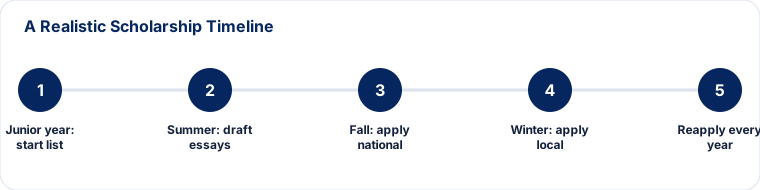
A realistic scholarship timeline
| When | Action |
|---|---|
| Junior year of high school (or a year before enrolling) | Start a spreadsheet of scholarships, deadlines, and requirements; ask your counselor for a local list. |
| Summer before senior year | Draft one or two core essays you can adapt for multiple applications; request letters of recommendation. |
| Fall of senior year | Apply to college-specific and early-deadline national scholarships; many large national awards close by December or January. |
| Winter/spring | Apply to local and community scholarships, which often have later deadlines and less competition. |
| After admission | Ask each college's financial aid office how outside scholarships will affect your award package. |
| Every year enrolled | Reapply annually — most scholarships are one-time or require renewal, not automatic for all four years. |
Frequently asked questions
Do I need good grades to get any scholarship?
No. Many scholarships are need-based, identity-based, or tied to an essay, community service, or a specific field of study rather than GPA or test scores.
Can I apply for scholarships before I'm admitted to a college?
Yes, and you should. Most outside scholarships (as opposed to institutional ones) do not require proof of admission at the time of application, only proof of enrollment before funds are disbursed.
Are scholarships taxable?
Scholarship money used for tuition, required fees, and required course materials is generally tax-free; amounts used for room, board, or travel are generally taxable. Consult a tax professional or IRS Publication 970 for specifics.
What if I don't win enough scholarships to cover the gap?
Combine scholarship search with the FAFSA process (see our financial aid guide) to identify grants, need-based aid, and reasonable federal loan options, and talk to each college's financial aid office about your specific gap before assuming private loans are the only option.
Can adult and returning students apply for scholarships too?
Yes. Many scholarships have no age restriction, and some are specifically reserved for adult learners, career-changers, or parents returning to school. Search databases typically allow filtering by "non-traditional" or "adult student" status, and community foundations often fund local awards with no age limit at all.
Do scholarships count as income that affects next year's FAFSA?
Scholarship and grant aid used for qualified education expenses generally is not counted as income on a future FAFSA, but the details depend on how the funds were used and reported for tax purposes. When in doubt, consult a tax professional or the financial aid office.
