

The five credential levels, at a glance
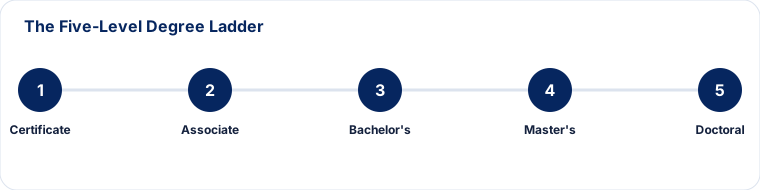
U.S. higher education is organized into five broad credential levels — certificate, associate, bachelor's, master's, and doctoral — each building on the one before it in scope, specialization, and, in many fields, legal authority to practice. Choosing the right level for a given goal is at least as important as choosing the right field or the right school, and it is a decision that should be made deliberately rather than defaulted into, since the wrong level can mean paying for education you don't need, or, in licensed fields, discovering too late that you haven't earned enough education to practice at all. This page gives a short overview of each level and links to a full page on each with typical credits, cost, curriculum structure, and financial aid specifics — use it as a map before diving into the field-specific detail on the program pages.
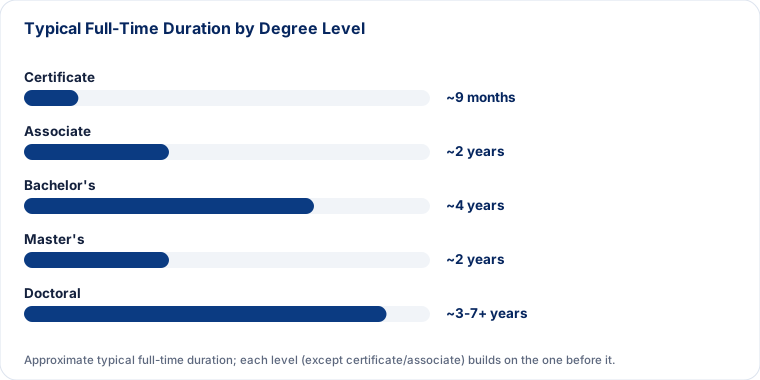
| Level | Typical credits | Typical full-time duration | Common role |
|---|---|---|---|
| Certificate | 9-45 credits | A few months to about 1 year | Focused skill credential; entry or supplement |
| Associate | 60-66 credits | About 2 years | Terminal entry credential in some fields; transfer credential in others |
| Bachelor's | 120-128 credits | About 4 years | Baseline entry credential for most professional fields |
| Master's | 30-36+ credits beyond the bachelor's | 1-3 years, commonly 2 | Required for some licensure; advancement/specialization in others |
| Doctoral | 30-90 credits plus dissertation or clinical training | 3-7+ years beyond the bachelor's or master's | Terminal research credential (PhD) or entry practicing credential for licensed professions (MD, JD, PharmD, DDS, DNP) |

Friendly editorial photography gives long research pages a natural visual pause while the detailed data, sources, tables, and guidance stay central.
Education photo via UnsplashCertificate
A certificate is the fastest, most narrowly focused credential, built around a specific skill set rather than a full academic program. It can serve as a quick entry point into a technical role, a supplement to an existing degree, or a way to test interest in a field before committing to a longer program. Certificates vary enormously in length, cost, and financial aid eligibility — see the full certificate page for specifics, including which programs typically qualify for federal aid and which do not.
Associate degree
An associate degree is a two-year credential, most often from a community or technical college, that plays one of two distinct roles depending on the type: an Associate of Applied Science (AAS) is usually a terminal, career-ready credential in a specific technical or applied field, while an Associate of Arts/Science (AA/AS) is usually built to transfer into the first two years of a bachelor's program. Knowing which type your target field and goal require matters more than the credential level alone — see the full associate degree page for the difference in practice and how transfer agreements typically work.
Bachelor's degree
The bachelor's degree is the standard four-year credential and the baseline requirement for the largest share of professional, managerial, and licensed roles covered on this site. It combines general education, a major, and often a capstone or internship experience. See the full bachelor's degree page for typical curriculum structure, realistic time to completion, and cost.
Master's degree
A master's degree sits on top of a bachelor's degree and plays different roles by field: a hard licensure requirement in some (nurse practitioner, clinical social work, school counseling), and an optional advancement or specialization credential in others (business, many engineering and technology fields). See the full master's degree page for how to tell which situation applies to your field, and how financial aid differs from the undergraduate level in ways that affect total cost planning.
Doctoral degree
"Doctoral degree" actually covers two different kinds of credential: a research-focused PhD (or EdD) built around an original dissertation, typically leading to academic or senior research careers, and a professional doctorate (MD, JD, PharmD, DDS/DMD, DNP) that is simply the standard entry-level practicing credential for a licensed profession, not an optional additional layer on top of it. See the full doctoral degree page for how funding, timeline, and purpose differ sharply between the two.
How financial aid changes as you move up a level
Financial aid rules shift meaningfully between undergraduate and graduate study, which is worth understanding before assuming aid works the same way at every level. Federal Pell Grants — the largest source of free federal aid money, currently up to $7,395 for the 2026-27 award year — are available to eligible undergraduates at the certificate, associate, and bachelor's levels, but do not extend to master's or doctoral study. Federal Direct Subsidized Loans, where the government pays interest while a student is enrolled, are also undergraduate-only; graduate and professional students borrowing federal loans use Direct Unsubsidized Loans and, in many programs, Direct Grad PLUS Loans instead, both of which accrue interest immediately and carry higher borrowing limits than undergraduate loans. At the doctoral level, funding structures diverge sharply by degree type: research PhD students in many fields are commonly funded through assistantships that waive tuition and pay a stipend, while professional doctorate students (MD, JD, PharmD, DDS, DNP) typically self-fund through a combination of loans, savings, and institutional aid. See our full financial aid guide for the mechanics of each aid type in more depth.
Thinking about return on investment across levels
A higher credential level does not automatically mean a better return on investment for a given individual — it depends on whether the field genuinely rewards that additional level, and by how much, relative to its added cost and time. In fields with a hard licensure floor (law, medicine, pharmacy, dentistry), the "return on investment" question is somewhat moot, since the credential is simply required to practice at all, and the real analysis is about total borrowing versus realistic post-licensure income. In fields without a hard floor, the calculation is genuinely open: a shorter, cheaper credential that meets a field's real minimum requirement and lets a student start earning two or three years sooner can outperform a longer, more expensive credential in total lifetime financial terms, even if the longer credential leads to modestly higher pay per year, once time value of money, forgone early-career earnings, and any additional debt taken on to fund the extra years are all factored in together rather than looked at in isolation. Our careers page walks through how to use BLS wage and outlook data to run this comparison for a specific field rather than relying on general assumptions about "more education always pays off," which is broadly true in aggregate national data but not automatically true for every individual field-and-program combination.
How to choose the right level
Start from your target field and role, not from a general sense of how much education "sounds right." The 50 program pages on this site each note the typical minimum credential and licensure pathway for that specific field — some fields have a hard floor (a JD to practice law, a PharmD to practice pharmacy), while others have real flexibility (many business, communications, and technology roles value demonstrated skills and experience alongside, or sometimes instead of, a specific credential level). Once you know the field's real floor, weigh time and cost against how quickly you need to start earning, whether your target role rewards specialization enough to justify a further credential, and whether your field has a credential-stacking path that lets you start working sooner and add credentials later without starting over. When two levels both seem plausible for your goal, the tie-breaker is usually the specific job postings you actually want to apply to — read several current listings for your target role directly and note which credential level they list as required versus preferred, rather than relying on general assumptions about the field.
Credential stacking: moving between levels
Many students don't complete all their education in one continuous stretch, and that's increasingly normal rather than an exception. "Stacking" describes deliberately structuring credentials so each one builds on the last without repeating work: an associate degree with a clear articulation agreement into a specific bachelor's program, a bachelor's-to-master's bridge that lets strong students begin graduate coursework in their senior year, or a graduate certificate that later counts toward a full master's degree if a student decides to continue. Stacking only works when the specific credentials involved have a formal, confirmed relationship — assuming credits will transfer or count without checking directly with both the sending and receiving program is one of the most common and costly planning mistakes in this area. Community college systems in many states publish formal statewide articulation agreements guaranteeing specific associate degrees will transfer in full to specific public four-year programs; graduate certificate programs sometimes, but not always, allow their credits to apply toward a related master's degree if a student later enrolls in the full program at the same institution. In both cases, get the transfer or stacking arrangement confirmed in writing, or at minimum from an academic advisor at the receiving institution, before assuming it will happen automatically.
Building a multi-level plan
For fields with a genuine multi-level requirement — nursing (ADN or BSN, then optionally MSN or DNP), accounting (bachelor's plus additional credit hours for CPA licensure, sometimes via a master's), or any field requiring graduate licensure — it helps to map the entire path from where you are now to your ultimate goal before choosing the first program, rather than deciding one level at a time in isolation. A plan built this way surfaces stacking opportunities (and their formal requirements) early, avoids paying twice for overlapping general-education content, and gives a clearer, more accurate total cost and timeline than evaluating each credential level as an independent decision.
Frequently asked questions
Do I need to complete every level in order?
No. Many fields allow entry at the level that matches the target role directly — an associate degree for an ADN-prepared registered nurse, for example, without first earning a certificate. Some graduate programs also admit directly from a bachelor's degree without requiring a separate master's first.
Which level offers the best return on investment?
There's no universal answer — it depends entirely on the field, the specific program's cost, and the credential actually required for your target role. A shorter, cheaper credential that meets your field's real requirement can outperform a longer, more expensive one that adds credentialing beyond what the role needs.
Can I complete multiple levels entirely online?
Increasingly yes, across all five levels, from accredited institutions — though fields with required clinical, lab, or practicum components (nursing, many sciences, teaching) typically require some in-person or supervised-placement component regardless of how the coursework itself is delivered.
Where should I start if I'm not sure which level I need?
Start with the program page for your field of interest, which notes the typical minimum credential and licensure pathway, then read the specific degree-level page linked from this one for the practical details of time, cost, and curriculum at that level.
Does a higher degree level always mean higher pay?
On average across the whole U.S. labor market, yes — BLS and Census data consistently show higher median earnings at each successive credential level in aggregate. But that national average masks huge field-by-field variation, and a highly experienced professional with a lower credential level in a strong field can out-earn a less experienced holder of a higher credential in a weaker one. Use field-specific BLS data (see our careers page) rather than the aggregate national trend when making an individual decision.
Is it ever worth going backward — earning a lower-level credential after a higher one?
Occasionally, yes. Career-changers sometimes deliberately pursue a shorter, lower-level credential (a certificate or associate degree) in a new field rather than a second bachelor's or master's degree, when the new field's real requirement is lower than their existing credential level and speed matters more than credential symmetry.
