

51 guides, organized by stage
College planning touches admissions, finances, immigration, housing, and everyday campus logistics, and no single reader needs all of it at once — a first-generation high school junior researching majors has almost nothing in common, timeline-wise, with an adult learner comparing evening MBA programs or an international student assembling visa paperwork. Organizing by stage and by audience, rather than alphabetically or by publish date, is meant to get you to the specific guide relevant to your actual situation as quickly as possible, rather than making you read past several sections that don't apply to you before reaching the one that does.
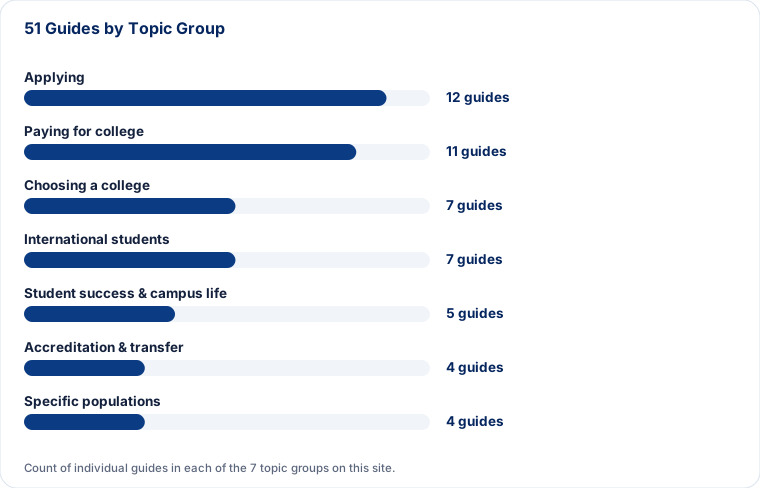
The guides below break the college planning process into specific, actionable topics rather than one long generic checklist. We've grouped them into seven stages that roughly track a typical timeline — choosing a college, applying, paying for it, understanding accreditation and transfer, navigating the process as an international student, succeeding once enrolled, and support specific to particular student populations — though you're welcome to jump directly to whichever topic is relevant to you right now rather than reading in order. Parents and school counselors supporting a student through this process may find it useful to skim the group headings first to see the full shape of the process before diving into any individual guide, since knowing what's coming later (financial aid comparison, transfer credit questions, arrival logistics) can inform decisions made earlier in the process, like which schools to apply to in the first place.

Friendly editorial photography gives long research pages a natural visual pause while the detailed data, sources, tables, and guidance stay central.
Education photo via UnsplashBrowse by topic
Choosing a college
Before applications and deadlines take over, these guides help you narrow a long list of possible schools and majors into a realistic shortlist — factoring in fit, format, safety, and how a major connects to your goals, not just name recognition or a single ranking's ordering.
Applying
The application process has more moving parts than most students expect: essays, recommendation letters, testing decisions, and a handful of different admission plans (early action, early decision, rolling, regular) each with their own tradeoffs and deadlines. These guides walk through each piece individually, so you can spend your limited time on the parts of the application that actually differ from school to school rather than re-learning the basics for every application.
Paying for college
Cost is usually the single most consequential factor in a college decision, and it's also the area where families most often leave money on the table simply by not knowing a specific aid type or comparison technique exists. These guides complement our full financial aid guide with process-specific, step-by-step detail, from reading a cost sheet correctly to comparing two very differently formatted award letters side by side.
Accreditation & transfer
Accreditation and transfer credit decisions are easy to get wrong in ways that are expensive or time-consuming to fix later. These guides cover the mechanics of verifying accreditation and moving credits between institutions, including into graduate school, and complement the deeper conceptual treatment on our full accreditation guide.
International students
Applying to a U.S. college from outside the country adds an entire additional process on top of standard admissions — visas, testing, financial documentation, and logistics — covered here in the same practical, checklist style used throughout the rest of this section. See our full international students guide for the complete F-1 visa process these guides break into individual steps.
Student success & campus life
Getting admitted is the beginning, not the end, of the college process. These guides cover the practical side of actually attending — internships, career services, housing, meal plans, and studying abroad — that affects day-to-day experience and long-term outcomes alike, well beyond the admissions decision itself.
Support for specific student populations
Several groups of students face planning considerations that general college-search advice doesn't address well. These guides are written specifically for first-generation students, adult and returning learners, veterans and military-affiliated students, and students with disabilities, addressing the specific offices, benefits, and accommodations relevant to each group rather than treating them as an afterthought within general advice.
How to use these guides
Each guide focuses narrowly on a single decision point or process step, with a practical checklist structure rather than a broad overview — the goal is that you can open the specific guide relevant to whatever you're doing this week (drafting an application essay, comparing two financial aid offers, preparing for a college interview) and walk away with a concrete next action, rather than a general sense of the topic. Where a guide overlaps with one of our deeper pillar pages — financial aid, accreditation, scholarships, international students — we link to that page for the fuller treatment and keep the guide itself focused on the specific process step. Most guides end with a short checklist you can copy into your own notes or spreadsheet, since a static page is easy to read once and forget, while a checklist is something you can actually act on and revisit as you move through the process.
Why one topic per guide, instead of a single long page
It would be possible to combine all of this into a single, very long "how to apply to college" article, and many sites do exactly that. We chose narrower, single-topic guides instead for a practical reason: the questions readers actually have are specific ("what does the CSS Profile ask for that the FAFSA doesn't?" or "how does a college waitlist actually work?") rather than general, and a single long page makes it harder to find, bookmark, and return to the specific answer you need at the specific moment you need it — drafting an essay in October looks different from comparing aid offers in April, even though both are part of the same broader process. Splitting the content this way also lets each guide go deeper on its specific topic than a single combined article reasonably could, and it makes each guide easier to update independently as specific rules or deadlines change, without needing to revise an enormous combined document every time one small, specific detail shifts somewhere within it.
How these guides map to a typical timeline
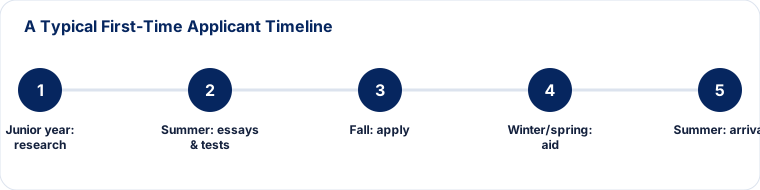
While every student's timeline differs, a rough sequence for a traditional first-time college applicant looks like: junior year of high school for initial college and major research (see the "Choosing a college" group), summer before senior year for essay drafting and testing decisions, fall of senior year for applications and early admission plans, winter into spring for financial aid comparison and the FAFSA, and the summer before enrollment for housing, orientation, and arrival logistics. Adult, transfer, graduate, and international applicants follow meaningfully different timelines — often compressed, sometimes extended around work or family obligations — which is part of why we maintain separate guides for those populations rather than assuming the traditional first-time-freshman timeline applies universally. If your situation doesn't match the traditional sequence at all, use the group headings above to identify the guides most relevant to your actual next step instead of trying to force your timeline into this general framework.
What these guides are not
These are general educational and organizational guides, not legal, financial, or immigration advice specific to your situation. For anything with binding legal or financial consequences — a specific visa application, a loan contract, a school's official policy on deferral or transfer credit — the guide will point you to the office or agency with actual authority over that decision (a school's financial aid office, an immigration attorney, the specific college's registrar), and that source's answer governs over any general guidance here. This is the same principle described on our About page: we aim to tell you what to look for and which office or agency to ask, rather than presenting general educational content as a substitute for an authoritative, situation-specific answer.
Frequently asked questions
Do I need to read these in order?
No — each guide stands alone. The grouping is meant to help you find the right one quickly, not to imply a required sequence.
How current is the information in these guides?
We review guides against primary sources on an ongoing basis; guides referencing specific dollar figures or deadlines (FAFSA, loan limits) note the year those figures apply to and link to the official current source.
Can I suggest a topic that isn't covered yet?
Yes — use the contact page to suggest additions, and let us know which stage of the process you were in when you noticed the gap.
Are these guides specific to any one state or type of college?
No — they're written to apply broadly across public, private, two-year, and four-year institutions in any state. Where something is genuinely state- or institution-specific (financial aid deadlines, transfer articulation agreements), the guide says so explicitly and points you to where to check for your specific situation.
I'm applying as a transfer or graduate student — do these still apply?
Many do, particularly the financial aid, accreditation, and transfer-credit guides, though the "Applying" group is written primarily for first-time undergraduate applicants. The "Graduate School Application Guide" and "Community College Transfer Guide" specifically address those alternate paths.
How do these guides relate to the pillar pages like Financial Aid and Accreditation?
Pillar pages (linked in the site footer under "Plan") give the full conceptual picture of a topic — how financial aid works overall, what accreditation means and how to verify it. Guides in this section take one specific step within that larger topic (comparing two award letters, reading a cost sheet) and walk through it in a shorter, more actionable format. Start with the pillar page if you're new to a topic, and come back to the specific guide when you're at that exact step.
How do I know this guide still reflects current rules?
Check the date on any specific dollar figure, deadline, or published requirement mentioned above against the official source it links to. Rules like these are set independently by government agencies, accreditors, and individual schools, and they can change from one academic year to the next, sometimes with little advance notice, so a guide written and reviewed at one point in time is a starting reference rather than a permanent, unchanging answer.