
What this directory is — and isn't
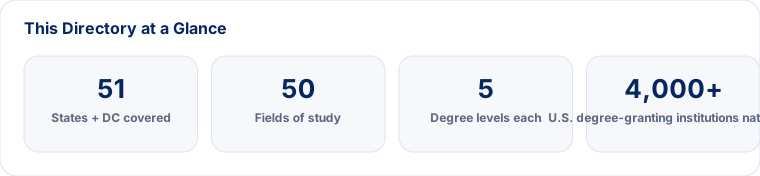
This section organizes research by state: all 50 states plus the District of Columbia, each with a page covering that state's major public university systems, primary state financial aid program, and the 50 fields of study covered on this site in a state-specific context, so you can approach a decision from whichever starting point makes sense for you — a field you already know you want, or a state you already know you'll be living in. It is not an exhaustive, individually reviewed list of every college and university in each state — there are more than 4,000 degree-granting institutions in the U.S., and a responsible individual review of each one is beyond what any single site can maintain accurately. Instead, treat each state page as a starting orientation: the state's major public systems, its financial aid landscape, and what's specific to researching that state, before you move to reviewing specific institutions directly through their own websites, the U.S. Department of Education's College Scorecard, and the relevant accreditor databases. This distinction matters because a state-level summary, however well sourced, cannot substitute for institution-specific facts that change independently of anything true about the state as a whole — a single college's accreditation status, net price, or program-specific outcomes can shift regardless of what's generally true about its state's higher-education landscape, which is exactly why the primary-source links on every state and program page matter more than the summary text itself.

Friendly editorial photography gives long research pages a natural visual pause while the detailed data, sources, tables, and guidance stay central.
Education photo via UnsplashBrowse by state
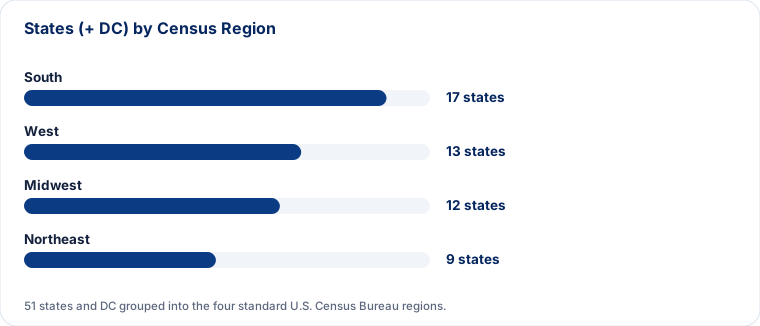
Northeast
Connecticut · Maine · Massachusetts · New Hampshire · New Jersey · New York · Pennsylvania · Rhode Island · Vermont
Midwest
Illinois · Indiana · Iowa · Kansas · Michigan · Minnesota · Missouri · Nebraska · North Dakota · Ohio · South Dakota · Wisconsin
South
Alabama · Arkansas · Delaware · District of Columbia · Florida · Georgia · Kentucky · Louisiana · Maryland · Mississippi · North Carolina · Oklahoma · South Carolina · Tennessee · Texas · Virginia · West Virginia
West
Alaska · Arizona · California · Colorado · Hawaii · Idaho · Montana · Nevada · New Mexico · Oregon · Utah · Washington · Wyoming
How to use a state page
Each state page names that state's major public university system(s) as a reference point, its primary state financial-aid grant program and the agency that administers it, and links into the 50 program areas covered on this site in a state-specific context — useful for understanding what's specific to that state (a state licensing board's name, a regional tuition exchange it participates in, a state grant program's typical eligibility) as distinct from what's true of a field nationally, which is covered on the corresponding program page. Use a state page as a launchpad into direct research: the named public university system's own site, the state higher-education agency's official page, and the specific program pages within that system, rather than as a complete substitute for that direct research. A useful habit is to open the state page and the relevant program page side by side — the state page tells you where to look and which agency to contact, while the program page tells you what to look for once you get there (accreditation, curriculum, and career data specific to the field). This two-page habit tends to surface questions worth asking an admissions or financial aid office directly, rather than leaving you with only a general impression of the state.
Public university systems: a starting reference
Nearly every state anchors its public higher-education system around one or more flagship university systems — the University of California and California State University systems in California, the State University of New York (SUNY) system in New York, the University of Texas and Texas A&M systems in Texas, and similar flagship-plus-regional-campus structures in most other states. These systems typically offer the broadest range of the 50 fields covered on this site, the most established in-state tuition rates, and the clearest connection to a state's primary financial aid program, and they are frequently the anchor institutions for programmatic accreditation in expensive-to-run fields like engineering, nursing, and the sciences, since maintaining specialized labs, clinical partnerships, and faculty research infrastructure is easier at scale. Private, nonprofit, and other public institutions in each state are also worth researching directly — this directory's state-level references to public systems are a starting point, not an implication that they are the only, or necessarily the best, option in that state for your specific field and goals. Community college systems, which exist in nearly every state and are frequently governed as a separate system from the four-year public university system, are worth researching in parallel, particularly for the associate-to-bachelor's transfer pathway described on our associate degree page, since transfer-friendly community colleges can meaningfully lower the total cost of a bachelor's degree earned at a state's flagship or regional public university, particularly when a formal statewide articulation agreement guarantees the credits will apply.
In-state considerations that vary by state
Every state sets its own residency requirements for in-state tuition, its own state financial aid program with its own eligibility rules and deadlines, and, for licensed professions, its own state licensing board with its own requirements. A handful of multi-state compacts (the Western Undergraduate Exchange, the Midwest Student Exchange Program, the New England Board of Higher Education's Regional Student Program, and the Southern Regional Education Board's Academic Common Market) offer reduced non-resident tuition for students attending certain public colleges in a neighboring member state — worth checking if you're considering a state you don't currently live in. See our full locations guide for how residency, tuition exchange, and licensure portability work in more depth, including how to establish in-state residency and how regulated professions handle licenses earned in one state but used in another.
The scale of U.S. higher education, briefly
The United States has more than 4,000 degree-granting postsecondary institutions recognized by the U.S. Department of Education, ranging from small, single-purpose technical colleges to large multi-campus public systems enrolling well over 200,000 students combined. That scale is exactly why a state-by-state, cluster-by-cluster approach is more useful than an attempt at an exhaustive individual list: even a diligent researcher benefits far more from knowing which few institutions in a given state anchor a specific field, which state agency administers financial aid, and which accreditor to check, than from a long undifferentiated list of every institution's name. Each state page on this site aims to give you that oriented starting point rather than an overwhelming, undifferentiated directory, in the same way a good reference librarian points you to the right shelf rather than handing you the entire catalog.
Why we group states into four census regions
The Northeast, Midwest, South, and West groupings used above follow the standard U.S. Census Bureau regional classification, and we use the same grouping consistently across this site's state, locations, and regional exchange content so the categories stay easy to cross-reference. These groupings roughly, though not perfectly, track where regional tuition-exchange compacts operate: the Western Undergraduate Exchange serves Western states, the Midwest Student Exchange Program serves Midwest states, the New England Board of Higher Education's Regional Student Program serves the six New England states within the Northeast, and the Southern Regional Education Board's Academic Common Market serves Southern states. If you're considering attending school outside your home state, checking whether both states participate in the same regional compact is one of the fastest ways to identify a potential tuition discount before assuming full out-of-state pricing applies. Participation and covered majors change from year to year and vary by receiving institution even within a member state, so confirm current terms directly with the specific college rather than assuming regional membership alone guarantees a discount for your intended major.
Turning this into a shortlist
- Start with your target field's program page to understand accreditation and licensure requirements nationally.
- Check your home state's page here for its major public systems and financial aid program, since in-state options are usually the lowest-cost starting point.
- If you're open to other states, check whether a regional tuition exchange applies before assuming full out-of-state tuition is your only option.
- Research specific institutions directly — their own websites, net price calculators, and the relevant accreditor's directory — using our comparison framework to evaluate them side by side.
- If a licensed profession is involved, confirm the specific state's licensing board requirements before finalizing a school, since licensure rules are set at the state level and a program that satisfies one state's board may not automatically satisfy another's.
- Revisit the financial aid and scholarships guides once you have a shortlist, since state-specific aid deadlines are often earlier than the federal FAFSA deadline and can affect which schools remain realistic options.
Treating this as a sequence — field first, then state and financial context, then specific institutions — tends to produce a shorter, more accurate shortlist than starting from a list of well-known school names and working backward, since it forces the objective, verifiable criteria to narrow the list before reputation and personal preference take over.
Frequently asked questions
Does this directory include private colleges?
State pages reference each state's major public university systems as a starting point, since they're relevant to in-state tuition and state financial aid; private and other institutions in each state are equally worth researching directly, and are not excluded from consideration by their absence from this summary-level reference.
Why doesn't this site rank or review individual colleges?
Responsibly ranking specific institutions against each other requires continuously verified, institution-specific outcomes data that this site does not independently maintain. We instead point you to primary sources — College Scorecard, accreditor directories, each college's own net price calculator — for institution-specific facts, and focus our own content on the research framework and field/state-level context around them.
How do I find every accredited college in a specific state?
The U.S. Department of Education's Database of Accredited Postsecondary Institutions and Programs (ope.ed.gov/dapip) lets you search and filter by state, and is the most authoritative, current source for a complete list, more current than any third-party summary, including this one, could reliably stay in a fast-changing regulatory area.
Is a state's page updated when its financial aid program changes?
We review state pages against primary sources on an ongoing basis, but state aid programs, amounts, and eligibility rules can change with little notice — always confirm current details directly with the state agency named on that state's page before relying on them.
Should I only consider colleges in my home state?
Not necessarily — but in-state public tuition is usually the lowest-cost baseline, so it's a reasonable starting comparison point even if you end up choosing an out-of-state or private option for other reasons (a stronger program in your field, a regional tuition exchange, or family circumstances).
What's the difference between a state's flagship university and its broader public system?
A "flagship" is typically the largest, most research-intensive campus in a state's public system (the University of Michigan in Ann Arbor, for example) — but most states also operate additional regional public campuses and, in several states, a large multi-campus system (like SUNY or the California State University system) offering many of the same fields at different campuses with different admission selectivity and cost.
Do I need to physically live in a state to attend an online program based there?
No — but confirm the specific program is authorized to enroll students from your actual state of residence (see our note on NC-SARA and state authorization on the locations page), since this is a separate question from simply being able to access the coursework online.
