

Why accreditation matters more than almost anything else
Accreditation is a voluntary, non-governmental quality-review process, but it functions as the gateway to nearly everything that makes a degree valuable: eligibility for federal financial aid, the ability to transfer credits between institutions, eligibility to sit for professional licensing exams, and, in many cases, whether an employer or graduate school will even consider the degree legitimate. A college can look polished, advertise heavily, and still not be accredited, or be accredited by an agency that is not recognized by the U.S. Department of Education — and confirming accreditation status takes about five minutes using free federal databases. Skipping that step is the single most common and most costly mistake in college research.
This distinction sounds abstract until it affects a real decision: a student who enrolls in an unaccredited program, or a programmatically unaccredited one in a licensed field, can complete every course, pay full tuition, and still be unable to sit for a licensing exam, transfer credits to finish elsewhere, or qualify for federal loan forgiveness programs. The rest of this page breaks accreditation into its two layers, shows which accreditor matters for each of the fields covered on this site, and gives a short, repeatable process for verifying status before you commit money or time.

Friendly editorial photography gives long research pages a natural visual pause while the detailed data, sources, tables, and guidance stay central.
Education photo via UnsplashInstitutional accreditation
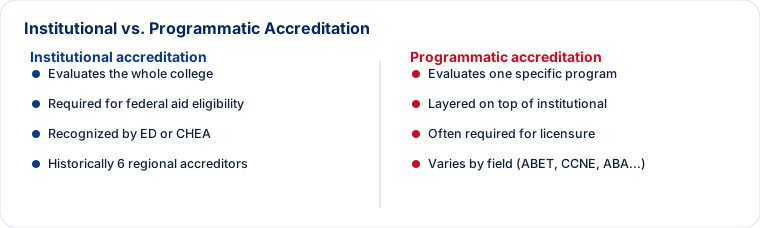
Institutional accreditation evaluates an entire college or university — its finances, governance, faculty qualifications, student outcomes, and academic quality — rather than a specific program. In the United States, institutional accreditors must be recognized by the U.S. Department of Education, the Council for Higher Education Accreditation (CHEA), or both, to carry weight for federal financial aid purposes. Historically these accreditors were organized by geographic region, and while the Department of Education eliminated the formal regional/national distinction in 2020 (allowing any recognized institutional accreditor to accredit colleges nationwide), the traditionally regional accreditors remain the most common institutional accreditors for public and private nonprofit colleges. They include:
- Higher Learning Commission (HLC) — historically the North Central region
- Middle States Commission on Higher Education (MSCHE)
- New England Commission of Higher Education (NECHE)
- Northwest Commission on Colleges and Universities (NWCCU)
- Southern Association of Colleges and Schools Commission on Colleges (SACSCOC)
- WASC Senior College and University Commission (WSCUC)
A separate set of national institutional accreditors (such as the Distance Education Accrediting Commission, DEAC, and several faith-based and career-college accreditors) also operate, primarily among online, career, and religious institutions. Neither category is inherently "better" than the other in principle, but employers, graduate programs, and licensing boards vary in how they treat degrees from each, so it is worth confirming acceptance directly with any graduate program or licensing board you plan to pursue later.
Programmatic (specialized) accreditation
Programmatic accreditation, sometimes called specialized accreditation, applies to a specific department or program within an institutionally accredited college — a nursing program, an engineering program, a business school. It is layered on top of, not a substitute for, institutional accreditation, and in regulated fields it is frequently a legal prerequisite for licensure. A nursing graduate from a program without CCNE or ACEN accreditation, for example, may find themselves ineligible to sit for the NCLEX-RN in their state, regardless of how strong the coursework was. This is the accreditation layer that is most often overlooked by prospective students and most consequential when it is missing.
Programmatic accreditors by field
The accrediting body that matters depends entirely on the field. Some of the most consequential examples:
| Field | Common programmatic accreditor(s) |
|---|---|
| Engineering & computing | ABET (Engineering Accreditation Commission / Computing Accreditation Commission) |
| Business | AACSB International, ACBSP, or IACBE |
| Nursing | Commission on Collegiate Nursing Education (CCNE) or Accreditation Commission for Education in Nursing (ACEN) |
| Medicine (MD / DO) | Liaison Committee on Medical Education (LCME) / Commission on Osteopathic College Accreditation (COCA) |
| Dentistry | Commission on Dental Accreditation (CODA) |
| Pharmacy | Accreditation Council for Pharmacy Education (ACPE) |
| Law | American Bar Association (ABA) |
| Social work | Council on Social Work Education (CSWE) |
| Teacher education | Council for the Accreditation of Educator Preparation (CAEP) or AAQEP, plus state licensure boards |
| Psychology (doctoral) | American Psychological Association (APA) |
| Public health | Council on Education for Public Health (CEPH) |
| Architecture | National Architectural Accrediting Board (NAAB) |
| Dietetics / nutrition | Accreditation Council for Education in Nutrition and Dietetics (ACEND) |
| Art, design & music | National Association of Schools of Art and Design (NASAD) / National Association of Schools of Music (NASM) |
Each program page on this site lists the programmatic accreditor(s) typically relevant to that field as a starting point for research, but accreditation status can change and not every college's program within a field carries the specialized accreditation, so always confirm current status directly for the specific program you are considering.
A short history: why "regional" accreditation still gets mentioned
For most of the 20th century, the U.S. Department of Education formally recognized institutional accreditors by geographic territory — a college in Ohio was reviewed by the North Central Association, one in Georgia by the Southern Association, and so on. In 2020, the Department eliminated the regulatory distinction between "regional" and "national" institutional accreditors, technically allowing any recognized institutional accreditor to review colleges anywhere in the country. In practice, the six historically regional accreditors listed above still accredit the large majority of public and private nonprofit four-year colleges, and the older regional/national language persists in casual use even though it no longer reflects a formal legal category. What has not changed is the underlying requirement: for federal financial aid purposes, an institution needs recognition from an accreditor the Department of Education recognizes, regardless of what that accreditor is called.
Accreditation and graduate school or employer acceptance
Accreditation status follows a graduate well beyond the financial aid office. Graduate and professional schools routinely require that an applicant's undergraduate degree come from an institutionally accredited college, and many require a specific programmatic accreditation for the undergraduate major itself — an unaccredited nursing or engineering degree, for example, can disqualify an applicant from graduate programs in the same field even if individual courses were rigorous. Employers vary more: large employers with formal degree-verification processes and government contractors are the most likely to check accreditation status closely, while accreditation matters less for employers who evaluate portfolios, certifications, or work samples directly. Licensing boards are the strictest of all — a state nursing, engineering, accounting, or teaching board will typically reject an application built on an unaccredited or non-programmatically-accredited degree outright, with no discretion to make an exception. Because the consequences compound (a degree that doesn't transfer, doesn't qualify for aid, and doesn't lead to licensure), verifying accreditation before enrolling is far cheaper than discovering a problem after paying tuition.
How to verify accreditation yourself
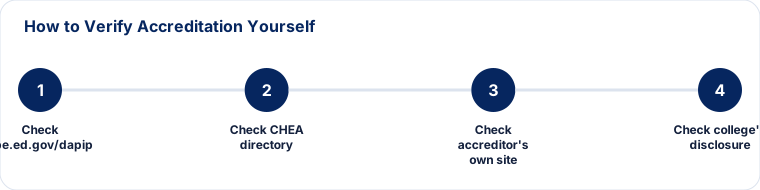
- U.S. Department of Education Database of Accredited Postsecondary Institutions and Programs (ope.ed.gov/dapip) — the federal government's official searchable database of accredited institutions and their accreditors.
- CHEA's directory of recognized accrediting organizations (chea.org) — confirms whether a given accreditor itself is legitimately recognized, which matters because some unrecognized "accreditors" exist specifically to make diploma mills look credible.
- The accreditor's own public directory. Every legitimate regional/institutional and programmatic accreditor publishes a searchable list of currently accredited institutions or programs on its own website, and most note the accreditation status (fully accredited, on probation, show-cause) in real time.
- The college's own disclosure. Federal law requires accredited institutions to disclose their accreditation status and accreditor; if a college is vague about this or only references accreditation in marketing copy without naming the accreditor, that is itself a warning sign.
Red flags of accreditation mills and unaccredited programs
- An accreditor you cannot find in the CHEA or Department of Education recognized-agency lists.
- Marketing language like "nationally accredited" or "fully certified" without ever naming the specific accreditor.
- A promise of a degree in an unusually short time with little coursework, or "life experience" credit for the majority of a degree.
- No physical accreditation review history, self-designed accrediting bodies, or accreditors that accredit only one institution.
- Pressure to enroll quickly, before you've had time to verify accreditation independently.
Understanding accreditation status labels
Accreditation is not simply a yes/no state; agencies publish intermediate statuses that are worth understanding before you enroll. "Accredited" or "fully accredited" means the institution or program has met the accreditor's standards as of the most recent review. "Candidate" or "pre-accreditation" status applies to new institutions or programs that are working toward full accreditation but have not yet achieved it — students enrolled during candidacy sometimes graduate before the program achieves full accreditation, which can matter for licensure timing, so ask directly. "Probation" or "show-cause" status means the accreditor has identified serious compliance problems and the institution has a limited window to correct them or lose accreditation entirely; enrolling during a probation period carries real risk. "Withdrawn" or "revoked" means accreditation has been formally removed. Accreditor directories typically display current status in real time, which is one more reason to check the accreditor's own site rather than relying solely on a college's marketing claims.
Accreditation for online and international programs
Online programs offered by an accredited college carry the same institutional accreditation as their on-campus counterparts — accreditation applies to the institution (and, where relevant, the specific program), not the delivery format. However, online students studying across state lines should also be aware of state authorization: under the National Council for State Authorization Reciprocity Agreements (NC-SARA), most states participate in a reciprocity framework that lets accredited institutions offer online programs to students in other member states without separate state-by-state licensing, but a small number of programs (particularly those leading to licensure, such as teaching or nursing) still require the student's home state to separately approve the specific program for licensure purposes. International students, and U.S. students considering a degree from a foreign institution, should know that foreign accreditation systems are not directly equivalent to the U.S. system; a credential evaluation from a recognized service (such as one accepted by NACES, the National Association of Credential Evaluation Services) is typically required before a foreign degree can be used for U.S. licensure, employment verification, or graduate admission.
Frequently asked questions
Is a "nationally accredited" school automatically legitimate?
Not necessarily. "Nationally accredited" is a real, historically defined category (as opposed to "regionally accredited"), but the term is also sometimes used loosely in marketing. What matters is whether the specific accreditor is recognized by the U.S. Department of Education or CHEA, which you can verify directly.
Can credits transfer between an institutionally accredited and an unaccredited school?
Generally, credits from an unaccredited institution do not transfer to an accredited one, and the reverse is not guaranteed either — transfer decisions are made by the receiving institution, so confirm transfer policy directly with any school you might move to later.
Does programmatic accreditation cost more?
Programs with specialized accreditation are not inherently more expensive, though accreditation review does have real costs for the institution. The larger financial risk is the opposite: paying tuition for a program that lacks the accreditation required for licensure in your state.
How often is accreditation reviewed?
Most accreditors conduct comprehensive reviews on a multi-year cycle (commonly every 5-10 years for institutional accreditation), with interim reports in between. Status can also change between cycles if an institution is placed on probation or show-cause.
If my school loses accreditation after I enroll, does my degree become worthless?
A degree earned while a program was accredited generally retains that status, but continuing to study, transferring credits, or pursuing licensure after an institution loses accreditation can become complicated. If your school's accreditation is placed on probation or show-cause, contact the accreditor and your state higher-education agency about teach-out and transfer options right away rather than waiting.