

How financial aid actually works
Most students do not pay a college's published "sticker price." They pay a net price that reflects the sticker price minus grants and scholarships, financed in part by loans and work-study earnings. Understanding the building blocks of a financial aid package — and which parts are free money versus borrowed money — is the single most useful skill in college planning. This page walks through each type of aid, how it is calculated, and how to build a timeline so you don't miss a deadline that costs you money.
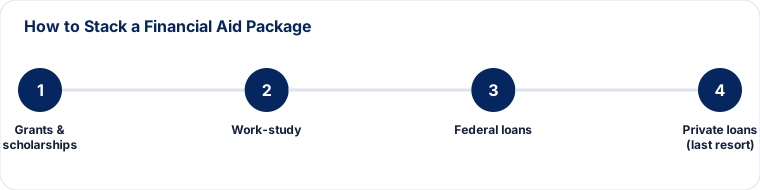
Financial aid in the United States comes from four sources: the federal government, state governments, the college or university itself, and private organizations (employers, foundations, and community groups). Each source has its own application, its own deadline, and its own rules, and a strong aid strategy applies to all four rather than assuming one form covers everything.

Friendly editorial photography gives long research pages a natural visual pause while the detailed data, sources, tables, and guidance stay central.
Education photo via UnsplashThe FAFSA and the Student Aid Index
The Free Application for Federal Student Aid (FAFSA) is the form that unlocks federal grants, federal work-study, and federal loans, and most states and colleges also use it to award their own aid. For the 2026-27 award year, the FAFSA became available on studentaid.gov ahead of the traditional October 1 launch date, and the federal deadline to submit it is June 30, 2027. That federal deadline is misleading, though: it is a ceiling, not a target. States and individual colleges set their own priority deadlines, many of them months earlier, and aid at the state and institutional level is frequently awarded on a first-come, first-served basis until funds run out. Filing as close to when the form opens as your tax documents allow is one of the highest-leverage things you can do.
The FAFSA calculates a Student Aid Index (SAI), which replaced the older Expected Family Contribution (EFC) formula. The SAI estimates how much a family can reasonably be expected to contribute toward college costs based on income, assets, family size, and the number of family members in college at the same time. Financial aid offices subtract the SAI (and other aid) from the college's cost of attendance to determine a student's financial need, and they build an aid package intended to close that gap — though in practice many colleges do not meet 100% of demonstrated need, which is why comparing award letters matters.
Some private colleges also require the CSS Profile, a more detailed form administered by the College Board that asks about home equity, retirement assets, and non-custodial parent income in ways the FAFSA does not. Check each college's financial aid page directly to see whether it requires the CSS Profile in addition to the FAFSA.
Federal and state grants
Grants are the most valuable form of aid because they do not need to be repaid. The largest federal grant program is the Federal Pell Grant, aimed at undergraduates with significant financial need. For the 2026-27 award year, the maximum Pell Grant award is $7,395, unchanged from the prior year, with a minimum award of $740 (10% of the maximum) for students with the smallest amount of calculated need. Because Congress can adjust this figure, always confirm the current maximum on studentaid.gov before building a budget around it.
Pell Grant eligibility is based primarily on the Student Aid Index, family size, and enrollment intensity (full-time versus part-time), and it is generally limited to a student's first bachelor's degree, capped at the equivalent of 12 semesters of full-time enrollment (Lifetime Eligibility Used, or LEU). Other federal grant programs include the Federal Supplemental Educational Opportunity Grant (FSEOG), awarded by individual colleges to students with exceptional need, and the TEACH Grant, which provides funding to students who commit to teaching in a high-need field at a low-income school for a set number of years after graduation (and converts to a loan if that service obligation is not met).
Federal student loans
Federal loans are borrowed money and should be evaluated on the same terms as any other debt: total amount, interest rate, and repayment terms. Direct Subsidized Loans are available to undergraduates with financial need, and the federal government pays the interest while the student is enrolled at least half-time. Direct Unsubsidized Loans are available regardless of need, and interest accrues from the day the loan is disbursed.
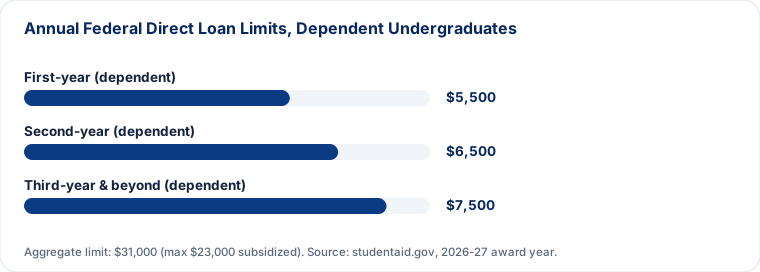
For dependent undergraduate students, annual federal loan limits are $5,500 for first-year students (up to $3,500 of which can be subsidized), $6,500 for second-year students (up to $4,500 subsidized), and $7,500 for third-year and beyond (up to $5,500 subsidized). The aggregate limit for dependent undergraduates is $31,000, of which no more than $23,000 can be subsidized. These figures have not changed for the 2026-27 award year, but loan rules are periodically revised by Congress, so confirm current limits and terms at studentaid.gov before finalizing a plan. Graduate students and independent undergraduates have different, generally higher limits, and graduate students may also be eligible for Direct PLUS Loans, which require a credit check.
Before borrowing, run the numbers on realistic post-graduation income for the field you are considering — the program pages on this site link to Bureau of Labor Statistics wage and outlook data by occupation for exactly this reason — and treat total borrowed debt as something that should stay proportionate to expected starting salary.
Federal Work-Study
Federal Work-Study provides part-time jobs, often on campus or with approved community and nonprofit employers, so students can earn money to help pay education costs. It is awarded as part of a financial aid package based on need and a college's available funding, and unlike a grant, the money is earned through hours worked rather than distributed as a lump sum. Not every college participates, and funding is limited, so students interested in work-study should ask their financial aid office directly about availability and typical award size.
Institutional aid and comparing net price
Colleges award their own grants and scholarships from institutional funds, and the criteria vary widely: academic merit, artistic or athletic talent, first-generation status, residency, or simply a college's strategy for building its incoming class. Because published tuition rarely reflects what a specific student will actually pay, use each college's net price calculator — a tool that federal law requires every degree-granting institution to publish on its website — to get a personalized estimate before applying. When award letters arrive, compare the actual net price (cost of attendance minus grants and scholarships) rather than comparing sticker prices or loan totals alone, and be alert to award letters that blend grants and loans together without clearly labeling which is which.
State grant programs
Every state operates at least one need-based or merit-based grant program funded through its own higher-education agency, and these programs are frequently underused simply because students do not know they exist or miss the (often early) state FAFSA priority deadline. The state pages on this site name each state's primary grant program and administering agency as a starting point — for example, California's Cal Grant (California Student Aid Commission), Texas's TEXAS Grant (Texas Higher Education Coordinating Board), and New York's Tuition Assistance Program (NYS Higher Education Services Corporation) — but eligibility rules, award amounts, and deadlines change from year to year, so confirm current details directly with the state agency before relying on them in a budget.
Military, veteran, and other special-circumstance aid
Several categories of students have aid pathways that run alongside the standard FAFSA process. Veterans and eligible dependents may qualify for GI Bill benefits (Post-9/11 GI Bill, Montgomery GI Bill, or the Yellow Ribbon Program for costs above public in-state tuition), administered through the Department of Veterans Affairs rather than Federal Student Aid; the VA's benefit comparison tool and a college's designated veterans certifying official are the right starting points. Active-duty service members and spouses may also qualify for tuition assistance programs specific to their branch. Students who were in foster care, are considered unaccompanied homeless youth, or are wards of the court often qualify for independent student status on the FAFSA, which changes how the Student Aid Index is calculated by removing parental income and assets from consideration, and many states operate dedicated tuition waivers for current or former foster youth. Students with disabilities should ask about vocational rehabilitation funding through their state's VR agency, which in some cases can cover tuition and required accommodations. Because each of these pathways has its own paperwork and its own office, students in any of these categories benefit from contacting a financial aid office directly and asking what applies to their specific situation rather than assuming the standard FAFSA process covers everything.
A realistic financial aid timeline
| When | Action |
|---|---|
| Fall of senior year (or the year before enrolling) | Research net price calculators and each target college's aid deadlines; gather prior-prior-year tax information. |
| As soon as the FAFSA opens | File the FAFSA (and CSS Profile if required); list every college you are considering, even ones you have not been admitted to yet. |
| Within a few weeks of filing | Review the FAFSA Submission Summary for errors in income, assets, or family size; correct promptly if something is wrong. |
| As admission decisions arrive | Compare award letters using actual net price, not sticker price; ask financial aid offices directly about appeal processes if circumstances changed. |
| Before the enrollment deposit deadline | Confirm total borrowing, complete loan entrance counseling and a Master Promissory Note if borrowing federal loans, and accept only the aid you plan to use. |
| Every year after the first | Refile the FAFSA annually — aid is not automatically renewed, and eligibility can change with income, family size, or academic standing. |
Common mistakes that cost students money
- Filing late or not at all. Some students assume they will not qualify for aid and skip the FAFSA; many state and institutional grants use it even for merit-based awards, and eligibility is often broader than families expect.
- Missing the state priority deadline. The federal deadline (June 30, 2027 for the 2026-27 cycle) is far later than most state deadlines, some of which fall as early as the prior fall.
- Comparing loan-heavy award letters as if they were equivalent to grant-heavy ones. A $30,000 package that is mostly loans is not the same as a $30,000 package that is mostly grants.
- Not appealing. Financial aid offices can often adjust an award if a family's circumstances have changed (job loss, medical expenses, a change in the number of siblings in college) — a professional judgment request is a normal, legitimate step.
- Paying for FAFSA help. The FAFSA is always free to file directly at studentaid.gov; be cautious of any site or service charging a fee to "process" it.
Frequently asked questions
Do I need to file the FAFSA every year?
Yes. Financial aid is awarded on an annual basis, and you must file a new FAFSA each academic year to remain eligible for federal, state, and often institutional aid.
Will applying for financial aid hurt my admission chances?
Most colleges in the U.S. are need-blind for admission, meaning financial aid applications are not considered in the admission decision, though a smaller number of colleges are need-aware. Each college discloses its policy; check before assuming either way.
What is the difference between a grant and a scholarship?
Both are aid that does not need to be repaid. In practice, "grant" often refers to need-based aid from the government or a college, while "scholarship" often refers to merit- or criteria-based aid from a college, employer, or private organization — but usage varies and the distinction is not strict.
Can I get financial aid for an online or part-time program?
Federal aid is available for many online and part-time programs at accredited institutions, but award amounts (particularly Pell Grants) are typically prorated by enrollment intensity. Confirm eligibility and award mechanics directly with the program's financial aid office.
