

50 fields, organized by cluster
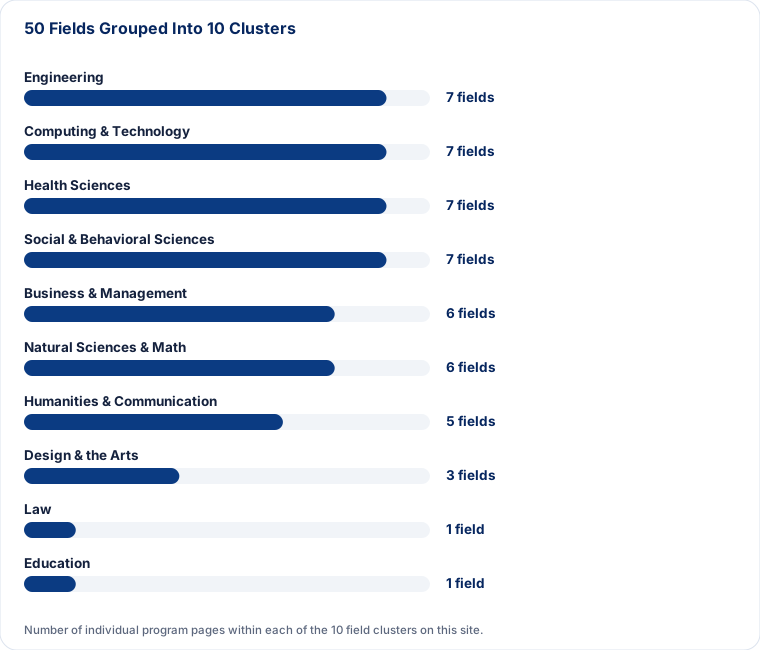
This site covers 50 fields of study, each with its own program page summarizing typical core coursework, the accreditation to verify, and BLS-sourced career and wage data. Rather than listing them alphabetically, we group them into ten broad clusters that roughly track how the U.S. Bureau of Labor Statistics organizes occupational data, since fields within the same cluster tend to share accreditation patterns, curriculum structure, and career trajectories even when the specific subject matter differs substantially from one field to the next within that same broad category.

Friendly editorial photography gives long research pages a natural visual pause while the detailed data, sources, tables, and guidance stay central.
Education photo via UnsplashBrowse by cluster
Business & Management
Business fields prepare graduates for management, finance, marketing, and operations roles across every industry, from small companies to multinational corporations and the public sector. Most undergraduate business programs pursue AACSB, ACBSP, or IACBE accreditation, which is worth verifying since it affects graduate-school recognition and some employer screening. BLS data shows business and financial occupations earning a May 2024 median wage of $80,920, above the $49,500 all-occupation median, with roles ranging from entry-level analyst positions to executive management.
Accounting · Business Administration · Finance · Hospitality Management · Human Resources · Marketing
Engineering
Engineering fields combine mathematics, physical science, and design to build physical and digital systems, from bridges and aircraft to microchips and biomedical devices. ABET accreditation is the single most important credential to verify for any engineering bachelor's program, since it is frequently a prerequisite for Professional Engineer (PE) licensure later in a career, particularly for engineers who sign off on public-facing designs. Architecture and engineering occupations had a May 2024 median wage of $97,310, well above the national median.
Aerospace Engineering · Biomedical Engineering · Chemical Engineering · Civil Engineering · Computer Engineering · Electrical Engineering · Mechanical Engineering
Computing & Technology
Computing fields cover software development, data science, cybersecurity, and IT infrastructure — some of the fastest-growing occupational categories tracked by BLS. Demand has been consistently strong: computer and information technology occupations had a May 2024 median wage of $105,990, well above the national median, with several specific roles (information security analysts, data scientists) projected to grow much faster than average through 2034. ABET computing accreditation is a useful signal to check for degree-focused (as opposed to bootcamp-style) programs in this cluster.
Artificial Intelligence · Computer Science · Cybersecurity · Data Analytics · Data Science · Information Systems · Software Engineering
Health Sciences
Health fields range from direct patient care (nursing, medicine, dentistry, pharmacy) to administration, nutrition, and population health. Nearly every field in this cluster has a programmatic accreditor tied directly to licensure eligibility — CCNE/ACEN for nursing, LCME/COCA for medicine, CODA for dentistry, ACPE for pharmacy — making accreditation verification especially consequential here, since an unaccredited program can leave a graduate unable to sit for the licensing exam regardless of academic quality. Healthcare practitioner and technical occupations had a May 2024 median wage of $83,090.
Dentistry · Healthcare Administration · Medicine · Nursing · Nutrition · Pharmacy · Public Health
Humanities & Communication
Humanities and communication fields build research, writing, critical analysis, and storytelling skills that transfer across law, media, business, education, and public-sector careers, often more broadly than a single job title suggests. Outcomes in this cluster vary more by the specific role and skills a graduate develops than by major title alone, which makes internships, writing samples, and a strong portfolio especially valuable relative to fields with a single clear occupational pipeline.
Communications · English · History · Journalism · Philosophy
Social & Behavioral Sciences
Social and behavioral science fields study individuals, institutions, and societies using research methods, statistics, and applied theory. Several fields in this cluster (psychology, social work) lead to licensed clinical practice at the graduate level and require specific programmatic accreditation (APA, CSWE) to reach that point, while others (political science, economics, anthropology, international relations) are more commonly research, policy, government, or generalist-career foundations rather than licensure-track fields.
Anthropology · Criminal Justice · Economics · International Relations · Political Science · Psychology · Social Work
Natural Sciences & Mathematics
Natural science and mathematics fields build quantitative reasoning and laboratory or field research skills that underpin much of the healthcare, technology, and research economy. Many graduates go on to research, technical, or graduate/professional study — medicine, dentistry, and pharmacy programs commonly recruit heavily from biology and chemistry majors — and BLS life, physical, and mathematical science wage data varies widely by specific occupation, industry, and required credential level.
Biochemistry · Biology · Chemistry · Environmental Science · Mathematics · Physics
Design & the Arts
Design and arts fields combine technical craft with creative practice, spanning visual design, architecture, and music. Programmatic accreditation from bodies like NAAB (architecture), NASAD (art and design), or NASM (music) signals a program has met discipline-specific standards for facilities, faculty, and curriculum. In several of these fields, portfolio quality and a demonstrated body of work matter as much as, or more than, the specific school's name recognition when it comes to hiring or admission to competitive graduate programs.
Architecture · Graphic Design · Music
Law
Legal education centers on the Juris Doctor (JD), an ABA-accredited professional doctorate required to sit for the bar exam in every U.S. state — there is no bachelor's-level path directly into licensed legal practice. Lawyers earned a May 2024 median wage of $151,160, with the profession projected to grow about as fast as the national average through 2034; paralegal and legal-assistant roles offer a related, non-JD entry point into the field.
Education
Education fields prepare classroom teachers, instructional specialists, and education leaders across early childhood through secondary and adult education. State teaching licensure, built on a CAEP- or AAQEP-aligned preparation program plus supervised clinical practice and a state licensure exam, is the credential that actually authorizes classroom teaching — a bachelor's degree with education coursework alone does not automatically confer it without completing the state-specific licensure process.
How to use a program page
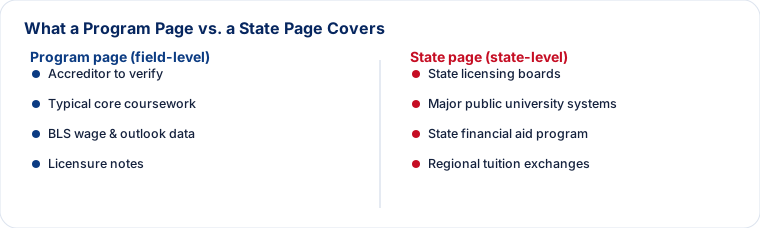
Each of the 50 program pages follows the same structure so you can compare fields consistently: a plain-language overview of the field, the programmatic accreditor(s) most relevant to verify (where one exists), typical core coursework you'd expect to see in a curriculum, BLS-sourced occupation, median wage, and job-growth data for roles connected to the field, and licensure or certification notes where the field has one. None of this is a substitute for reviewing a specific college's actual curriculum and accreditation status directly — it's a reference point so you know what to look for and what questions to ask when you do.
How this site structures each field
Each of the 50 fields has its own program overview page, plus five sub-pages covering that field at each degree level (certificate, associate, bachelor's, master's, doctoral), since curriculum, licensure requirements, and typical career paths shift meaningfully by credential level even within the same field — a certificate in accounting and a doctoral-track CPA path are both "accounting," but they lead to very different roles. Each field is also cross-referenced against every state through the state directory, which adds state-specific context: relevant state licensing boards, major public university systems known for that field, and state financial aid programs, without duplicating the field-level content already covered on the program page itself, so the two page types complement rather than repeat each other.
Choosing a field: a short framework
- Start broader than you think you need to. Browsing by cluster, rather than jumping straight to one major, often surfaces adjacent fields worth comparing (data analytics versus data science versus information systems, for example, or the various engineering disciplines).
- Check whether the field has a licensure floor. Fields like nursing, teaching, law, medicine, pharmacy, dentistry, accounting (for CPA status), and social work (for clinical licensure) have a specific credential and accreditation requirement that isn't optional — confirm it early, before falling in love with a specific program that doesn't satisfy it.
- Look at real BLS data for the field, not just anecdotes or a single school's marketing claims — see our careers page for how to read that data correctly.
- Cross-reference with a degree level. The degree-level pages explain how certificate, associate, bachelor's, master's, and doctoral study interact with a given field's requirements.
- Narrow to specific schools last, using the state directory and our comparison framework once you've settled on a field and degree level.
A note on STEM designation and international students
Several fields in the engineering, computing, and science clusters — along with some interdisciplinary programs in other clusters — carry a STEM (Science, Technology, Engineering, and Mathematics) designation under the Department of Homeland Security's CIP code classification, which matters specifically for international students on F-1 visas. A STEM-designated degree can qualify graduates for a 24-month Optional Practical Training (OPT) extension beyond the standard 12 months, for up to 36 months of total post-graduation work authorization. Not every program within a STEM-adjacent field is automatically STEM-designated; the designation is tied to the specific CIP code a college assigns the program, so international students should confirm a specific program's STEM designation directly with the school's international student office rather than assuming based on the field name alone, since two programs with very similar names at different schools can carry different CIP codes and different OPT eligibility as a result. See our international student guide for more on OPT.
Interdisciplinary and emerging fields
Several fields on this list — artificial intelligence, data science, and cybersecurity among them — are relatively young as standalone degree titles and sit at the intersection of older, more established departments (computer science, mathematics, statistics, electrical engineering). Programs in these emerging fields vary more in curriculum and rigor from school to school than programs in long-established fields with a more standardized curriculum, since there isn't always a single long-standing programmatic accreditor with decades of established norms for the newest specializations. This makes comparing actual course lists and faculty research areas between specific schools especially worthwhile in these fields, rather than assuming the degree title alone tells you enough about what you'll actually learn, particularly if you're choosing between two schools whose programs share a name but were built by different departments with different histories.
Frequently asked questions
Do these 50 fields cover every possible major?
No — they cover 50 of the most commonly searched and broadly applicable fields, chosen to span each major occupational cluster. Many more specific majors and interdisciplinary programs exist at individual colleges beyond this list.
Can I study more than one of these fields at once?
Yes, through a double major, a major-minor combination, or an interdisciplinary program — see our double major guide for how to weigh the extra time and cost against the benefit for your specific goals.
How current is the career data on each program page?
It's sourced from the BLS Occupational Outlook Handbook (May 2024 wage data; 2024-34 projections), gathered August 2026. BLS updates this data on its own schedule — each program page notes this and links to bls.gov for the current version.
What if a field I'm interested in isn't listed here?
Use the site search or contact page to let us know — we prioritize adding coverage for fields with high reader demand.
Are all 50 fields available at every degree level?
Most are, but not every level makes sense in every field — medicine, law, dentistry, and pharmacy are structured around a professional doctorate as the practicing credential, for example, so their "certificate" or "associate" pages describe pre-professional preparation rather than a path to independent practice at that level. Each program page notes this where it applies.
Do program pages recommend specific colleges?
No — program pages describe the field generally (typical curriculum, accreditation to check, career data) rather than ranking or recommending specific named institutions, since a responsible recommendation requires continuously verified, institution-specific data. Use the state directory and our comparison framework to evaluate specific schools once you've chosen a field.