

Overview
This page breaks down what to actually look for when comparing Physics programs: typical curriculum, the accreditor that actually matters for this field, and real career outcomes data from the U.S. Bureau of Labor Statistics, rather than marketing claims from any single school. Physics sits in the science cluster of fields covered on this site, alongside related programs you can browse from our full programs index.
Physics is offered at every degree level from certificate through doctoral at different institutions, though not every level leads to the same outcome or plays the same role in a career path — see "How the degree ladder works in this field" below for the specifics that apply here. Whether you're comparing your first program in this field or evaluating a second, more advanced credential, the same four questions apply: is the specific program accredited by the right body, does its curriculum actually match what employers or licensing boards expect, what do real (not marketed) outcomes look like, and what will it actually cost after aid. Keeping those four questions in view while reading the rest of this page — and while reading any individual school's own marketing material — is the single most useful habit for avoiding an expensive, hard-to-reverse mistake.

Friendly editorial photography gives long research pages a natural visual pause while the detailed data, sources, tables, and guidance stay central.
Education photo via UnsplashTypical curriculum
While exact course titles and sequencing vary by institution, a physics curriculum commonly includes:
- Classical Mechanics
- Electromagnetism
- Quantum Mechanics
- Thermodynamics and Statistical Mechanics
- Mathematical Methods for Physicists
- Laboratory Physics
- Modern Physics
- Independent Research
Compare this list against the actual course catalog of any specific program you're considering — a strong program will cover most of these areas in some form, and a program that's missing several of them, or that substitutes significantly lighter coursework, is worth asking about directly. Course titles vary by institution even when the underlying content is similar, so read course descriptions rather than relying on titles alone when making this comparison. Elective and concentration options built around this core coursework are where individual programs most often differentiate themselves, so ask what specializations or elective tracks a specific school actually offers within the field.
Accreditation to verify
For physics specifically, the field's primary programmatic accreditor to check is Regional institutional accreditation. This matters beyond a formality: for most of the fields on this site, missing programmatic accreditation can mean a graduate is ineligible for licensure, certification, or full transfer credit, regardless of how strong the coursework was. A short, repeatable verification process:
- Search the accreditor's own program directory for the specific institution and program name.
- Cross-check the institution's overall accreditation status in the U.S. Department of Education's Database of Accredited Postsecondary Institutions and Programs (ope.ed.gov/dapip).
- Ask the program directly for its current accreditation status in writing if you can't find it published, and be wary if a program is vague or evasive about naming its accreditor.
- Recheck accreditation status close to enrollment, since status can change between when you first research a program and when you actually enroll.
See our full accreditation guide for how institutional and programmatic accreditation work together, and why the distinction matters for financial aid eligibility as well as licensure.
Career outlook
Physics graduates commonly pursue roles including the following, with wage and outlook data from the BLS Occupational Outlook Handbook (May 2024 wages; 2024-34 projections), compared against the $49,500 median wage for all U.S. occupations:
| Related occupation (BLS) | Median annual wage (May 2024) | Job outlook (2024-34) |
|---|---|---|
| Physicists | $155,680 | about as fast as the average for all occupations (4% projected growth, 2024-34) |
| Astronomers | $128,950 | faster than the average for all occupations (8% projected growth, 2024-34) |
| Physics Teachers, Postsecondary | $92,640 | about as fast as the average for all occupations (3% projected growth, 2024-34) |
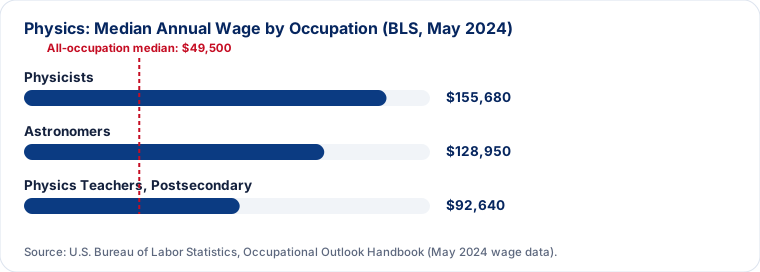
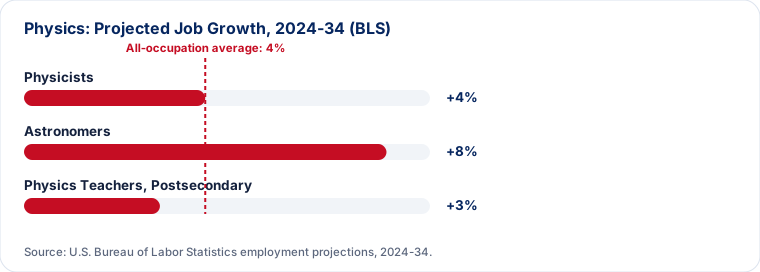
These are national figures; actual pay varies substantially by region, employer, and experience level, and entry-level pay in particular typically sits below the median shown here. See our careers page for how to read this data correctly, including how to find state- and metro-level wage figures for your specific location through BLS's OEWS program, and how to weigh job outlook figures against realistic competition in a specific local market. If you're comparing this field against a related one, run the same BLS lookup for both rather than relying on general reputation, since perceived prestige and actual median pay don't always move together.
Licensure & certification
Physics is not a licensed profession in the way nursing or law are — there is no single required licensing exam — though specific roles within the field may expect voluntary certifications.
How the degree ladder works in this field
Physics follows the standard five-rung academic ladder: a certificate offers a fast, narrow entry into specific tasks within the field; an associate degree provides foundational coursework, either as a terminal applied credential or as a transfer path into a bachelor's program; a bachelor's degree is the typical baseline for full professional entry; a master's degree adds specialization or management-track credentials; and a doctoral degree (a research PhD in most cases for this field) supports research and postsecondary teaching careers.
Explore each level in detail:
Format: online vs. on campus
Many Physics programs are now available online, in a hybrid format, or fully in person, and format flexibility has become one of the more consequential ways individual programs differ from one another. Fully online programs tend to suit working adults and students managing family or geographic constraints; in-person programs offer more direct access to labs, studios, or clinical facilities where the field requires them; hybrid formats attempt to combine both. This field does not typically require the kind of supervised clinical placement that limits online delivery, though specific programs may still include an internship, practicum, or capstone with in-person or employer-site components. Whichever format you're considering, confirm institutional accreditation applies equally to the online version of the program (it generally does, since accreditation applies to the institution and program rather than the delivery method) and, if you live in a different state than the institution, confirm the program is authorized to enroll students from your state — see our locations guide for how state authorization (NC-SARA) works.
Cost & financial aid
Total cost for a Physics program depends far more on the specific institution and your residency status than on the field itself, but the same financial aid mechanics apply across every field on this site: the FAFSA determines eligibility for federal grants, loans, and work-study; institutional and state aid layer on top; and net price (not published tuition) is the number that actually matters for comparison. See our full financial aid guide for current federal figures, and our degree-level pages for typical credit-hour and cost ranges at each level. Where Physics has field-specific cost drivers — required lab fees, clinical supervision costs, licensing exam fees, or extended clinical/residency training — those are noted in the licensure section above.
For reference, here is how credit hours and typical duration compare across all five levels (see our degree-level pages for full detail on each):
| Level | Typical credits | Typical duration |
|---|---|---|
| Certificate | 9-45 credits | A few months to about 1 year |
| Associate Degree | 60-66 credits | About 2 years |
| Bachelor's Degree | 120-128 credits | About 4 years |
| Master's Degree | 30-36+ credits beyond the bachelor's | 1-3 years, commonly 2 |
| Doctoral Degree | 30-90 credits plus dissertation/clinical training | 3-7+ years beyond the bachelor's or master's |
Specializations and electives
Beyond the core coursework listed above, most physics programs let students build a concentration through electives, a minor, or a formal track in the later years of study — this is typically where two programs with an identical-sounding title actually differ most in practice. When comparing specific schools, ask for the current elective and concentration course list (not just the core requirements), and ask how far in advance electives are scheduled, since some programs offer a wide catalog on paper but only run a narrow subset of it in any given term. Faculty research interests and industry partnerships often shape which concentrations a specific program is genuinely strong in, which is a more useful signal than the concentration simply being listed in a catalog somewhere.
How to evaluate a specific program
- Confirm institutional and (for this field) programmatic accreditation directly, using the steps above.
- Compare the actual course list against the core coursework above, and ask about available concentrations.
- Check outcomes data specific to the program — licensure pass rates where applicable, or graduate placement and continuing-education data.
- Get a personalized net price using the school's net price calculator, not published tuition.
- Use our comparison framework to weigh finalists side by side across accreditation, cost, curriculum, outcomes, and support.
- Talk to current students or recent graduates where possible — a program's own marketing materials describe intent, while people who actually completed it describe what happened.
- Revisit this checklist for every finalist individually rather than assuming a strong first impression at one school generalizes to how you'll evaluate the rest.
You can also research physics programs by state through our state directory, which adds state-specific context like relevant licensing boards, regional public university systems, and state financial aid programs.
Frequently asked questions
What's the fastest way into a physics career?
It depends on the field's real licensure floor. Check the degree-ladder section above — some fields let you enter the workforce at the associate or certificate level and add credentials later, while others expect a bachelor's degree as the practical baseline before you're competitive for entry-level roles.
Do I need a physics-specific degree, or is a related major acceptable?
This varies by employer and by whether the field has a licensure requirement. Where a specific accreditation or licensure pathway applies (see the sections above), the specific major and accreditation typically matter; in more general roles, a related quantitative or communication-heavy major is sometimes acceptable alongside relevant experience and a strong portfolio or internship history.
How do I find physics programs in my state?
Use our state directory to find state-specific context, then confirm program-specific accreditation and outcomes directly with each school you're considering in that state.
Is this wage and outlook data current?
It reflects BLS Occupational Outlook Handbook data (May 2024 wages; 2024-34 projections) gathered August 2026. BLS updates this data on its own schedule — confirm the current version at bls.gov/ooh before making a decision based on it.
Can I switch into physics from an unrelated bachelor's degree?
Often yes, particularly at the master's or graduate-certificate level, sometimes with required prerequisite coursework depending on how different your prior major is from this field. Contact specific graduate programs directly about prerequisite requirements for career-changers.
How do I compare two specific physics programs against each other?
Apply the "How to evaluate a specific program" checklist above to each, then use our full comparison framework to weigh accreditation, net cost, curriculum, outcomes, and support side by side using the same criteria for both.
Does this page reflect a specific college's physics program?
No — this page describes the field nationally, not any single institution. Use it as a checklist and reference point, then apply it to the specific schools you're actually considering, confirming details directly with each one.
