

Where to start
America EDU is a structured research resource for comparing U.S. colleges, degree programs, financial aid, and career outcomes, built to make dense regulatory and institutional information easier to act on. Rather than a single search box and a list of school names, the site is organized around the three questions most prospective students actually have: what field should I study, at what degree level, and where. Each of those questions has its own section — Programs, Degrees, and Universities — built to work together rather than as three disconnected lists, so a specific combination (nursing, at the associate level, in Missouri, for example) pulls together the field-level facts, the degree-level mechanics, and the state-level context you'd otherwise have to piece together from several unrelated sources. A fourth section, Schools, covers K-12 rather than higher education, for families researching earlier stages.
If you already know your field, start with its program page for accreditation, curriculum, and BLS-sourced career data. If you know your state, start with its state page for major public university systems and state financial aid programs, or cross into that state's version of your target field for the combination of both. If you're not sure where to start at all, the five-step process below walks through a reasonable sequence, and the "who this site is built for" section further down describes a few common starting situations in more detail.

Friendly editorial photography gives long research pages a natural visual pause while the detailed data, sources, tables, and guidance stay central.
Education photo via UnsplashHow this site is organized
Every page on this site falls into one of a few types, each serving a different purpose in your research:
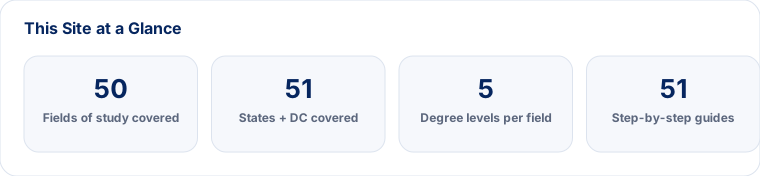
- Program pages (50 fields) cover a field of study nationally: typical curriculum, the accreditor to verify, licensure notes, and BLS wage/outlook data, plus a version of each page for every degree level within that field.
- Degree-level pages (certificate through doctoral) cover what a credential level actually requires — credits, time, cost, financial aid mechanics specific to that level, and how it fits the broader ladder, including how credits can stack from one level into the next.
- State pages (all 50 states plus DC) cover what's specific to researching a given state — its major public systems, its financial aid program and administering agency, and regional considerations like tuition exchange compacts and licensing boards.
- School pages cover K-12 schools rather than colleges — address and location, enrollment, student-teacher ratio, grade span, and reported incident data, drawn from the federal school directory and civil-rights collections. Every figure carries the year it comes from, and where federal data is suppressed or missing we say so rather than showing a zero. Browse them from the Schools section or read how we rate schools.
- Pillar guides — Financial Aid, Accreditation, Scholarships, Careers, Compare, Locations, and International Students — cover the cross-cutting topics that apply regardless of field or state, in the most depth of any page type on the site.
- 51 shorter guides cover specific process steps, from writing an application essay to comparing two award letters, organized by stage on our guides index.
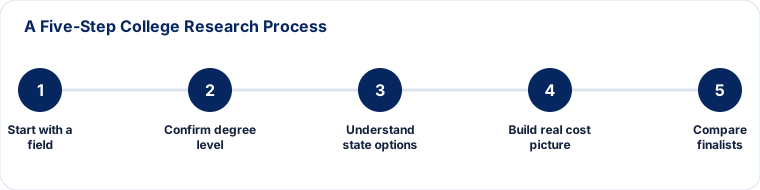
A five-step research process
- Start with a field, not a school. Browse Programs to understand what a field actually involves, its accreditation requirements, and realistic career outcomes before you start evaluating specific colleges. Starting from school reputation instead of field fit is one of the most common reasons students later switch majors, extending time to graduation and total cost in the process.
- Confirm the degree level your goal actually requires. Check the relevant degree-level page — some fields have a hard licensure floor (law, medicine, pharmacy, dentistry), while others offer real flexibility between an associate, bachelor's, or certificate path leading toward the same practical outcome.
- Understand your state options. Your home state's page is usually the lowest-cost starting point through in-state public tuition and state financial aid, and it's worth checking whether a regional tuition exchange (see our locations guide) opens up affordable out-of-state options too, particularly if a neighboring state offers a stronger program in your specific field.
- Build a real cost picture. Use our financial aid guide and each college's own net price calculator, not published sticker price, and treat federal loan limits as a ceiling to plan around rather than a target to automatically reach.
- Compare finalists systematically. Apply our comparison framework — accreditation, net cost, curriculum, outcomes, support, and fit — to whatever shortlist you land on, and write the results down in a simple table rather than relying on memory once several offers start arriving close together.
None of these steps requires visiting every page on this site in order — many readers arrive already partway through this process with a specific question in mind, and every page here is written to stand on its own as well as to fit into this broader five-step sequence.
What this site does and doesn't do
To be direct about scope: this site does not maintain individually researched, continuously verified profiles of specific named colleges, and it does not publish admission-chance predictions or real-time acceptance-rate data. What it does instead is organize the research process itself — the accreditation to check, the career data to reference, the financial aid mechanics to understand, and the state-specific context that applies — and point you directly to the primary sources (BLS, the Department of Education, studentaid.gov, each state's higher-education agency, and each college's own disclosures) for the institution-specific facts that change over time and that only the primary source can responsibly keep current. This is a deliberate choice, explained in more detail on our About page, and it shapes how every section of this site is built, including why our rankings section publishes evaluation criteria rather than a numbered list of named schools, and why our state pages describe major public systems and financial aid programs rather than attempting an exhaustive, individually reviewed list of every institution in the state.
Who this site is built for
College research looks different depending on who's doing it, and this site is built to work for several different starting points rather than assuming one. A traditional first-time applicant in high school typically starts broad, with a field and a rough sense of geography, and narrows over a year or more — the Programs and Universities sections and our stage-by-stage guides are built for that longer runway. A transfer or adult student often already has credits, a job, and a much shorter timeline, and cares more about our degree-stacking and transfer credit content than the general admissions guides. An international student has an entirely separate visa and documentation process layered on top of standard admissions, covered in our international student guide. A parent or counselor supporting someone else through this process may be most interested in the financial aid and comparison framework pages that help structure a family conversation around real numbers rather than general impressions. A career-changer moving into a new licensed field — nursing, teaching, accounting — often benefits most from the licensure and accreditation notes on the relevant program page, since the real question for that reader is usually "what credential do I actually need," not "which school has the best reputation."
Why we emphasize verification over convenience
A lot of college-planning content is built to be reassuring rather than accurate — confident-sounding rankings without visible methodology, career salary claims without a source, financial aid guidance that doesn't mention how often the rules change. We've built this site the opposite way: every factual claim on a pillar page is sourced to a primary source (the U.S. Bureau of Labor Statistics, studentaid.gov, the U.S. Department of Education's accreditation database, or a state's official higher-education agency), and every page tells you directly and specifically where to go to confirm the current version of that fact, since financial aid figures, accreditation status, and program requirements change over time. This shows up in small but important details throughout the site: our financial aid guide cites the actual 2026-27 Pell Grant maximum and federal loan limits rather than a vague "grants and loans are available"; our accreditation guide names the specific programmatic accreditor for each regulated field rather than saying "check that it's accredited"; our career pages cite specific BLS Occupational Outlook Handbook figures rather than unsourced salary ranges. Our About page explains this approach, our advertising model, and our correction process in more detail.
Popular starting points
If you'd rather jump straight to a specific page than follow the five-step sequence above, these are commonly useful entry points across every stage of the process:
Whichever page you start on, the same underlying approach applies throughout the site: specific, sourced information where we can verify it directly, honest pointers to the right primary source where verification requires institution- or situation-specific data, and a clear structure so you can find your way from a broad starting question down to a concrete, verifiable next action rather than a vague sense of having "done research."
Frequently asked questions
Is America EDU a college or does it process applications?
No. We're an independent research resource, not a college, government agency, or accreditor, and we don't process admissions, financial aid, or scholarship applications — see our About page for a fuller description of what we are and are not.
Does this site rank specific colleges?
No — we publish evaluation criteria for each field rather than a numbered ranking of named institutions, since responsibly ranking schools requires continuously verified, institution-specific data we don't independently maintain. See our rankings methodology page for the full reasoning and the evaluation framework we use instead.
How current is the information on this site?
Figures tied to a specific date (financial aid amounts, loan limits, BLS wage data) note when they were last verified and link to the primary source so you can confirm the current version, since these figures change over time and no third-party summary, including this one, should be treated as the final authority over the primary source itself.
Where should I go if I have a question specific to one college?
Contact that college's admissions or financial aid office directly — they hold the authoritative, current answer for anything specific to their institution. Use this site to know what to ask, since arriving prepared with the right questions tends to get a faster, more useful answer from a busy admissions or financial aid office.
Do I need to create an account to use this site?
No — educational pages and exam practice are freely accessible without registration. An optional verified account is available for features such as submitting a review. Create or verify an account, or see our privacy policy for how account and browsing information is handled.
How do I search this site for a specific topic?
Use the search bar in the header, or go directly to Search and enter a program, state, degree level, or topic like "financial aid" or "nursing in Texas." Results link straight to the relevant page rather than a generic list.
What if I'm not sure which field or state I want yet?
Start with the five-step process above, or browse Programs by cluster to see the full range of fields covered, which often surfaces options you hadn't considered alongside ones you already had in mind, since fields are grouped with related ones rather than presented as an isolated alphabetical list.
Wherever you start, treat every figure and framework on this site as a well-sourced starting reference rather than a final answer for any single school — the primary-source links throughout point you to where a fact can be independently confirmed before you rely on it for an enrollment or financial decision.
