

What a associate degree actually is
The associate degree occupies a specific, often underrated place in U.S. higher education: it is simultaneously a complete, licensable credential in some fields and a stepping-stone credential in others, and knowing which category your intended field falls into changes how you should plan your first two years.
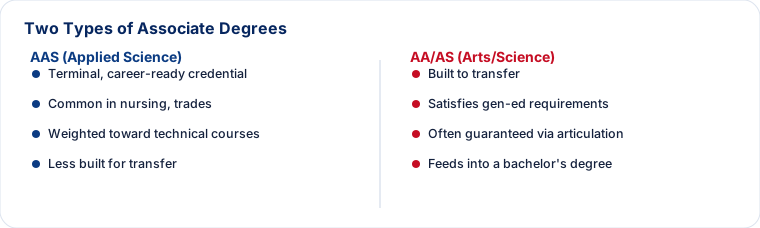
An associate degree is a two-year credential, most often awarded by a community or technical college, that either prepares a graduate for direct entry into a specific occupation (an Associate of Applied Science, common in fields like nursing, criminal justice, and many technical trades) or is designed to transfer into the first two years of a bachelor's degree (an Associate of Arts or Associate of Science).
The rest of this page covers the practical specifics — typical time and cost, how the curriculum is usually built, who this level tends to fit well, and where it sits relative to the other four credential levels covered on this site. As with every page here, treat the figures below as a well-sourced starting reference, and confirm exact numbers for any specific program directly with that program before enrolling, since real programs vary around these national norms in both directions.

Friendly editorial photography gives long research pages a natural visual pause while the detailed data, sources, tables, and guidance stay central.
Education photo via UnsplashTypical time, credits, and cost
| Factor | Typical range |
|---|---|
| Credit hours | 60-66 credits |
| Time to complete (full-time) | About 2 years of full-time study (often longer for part-time students) |
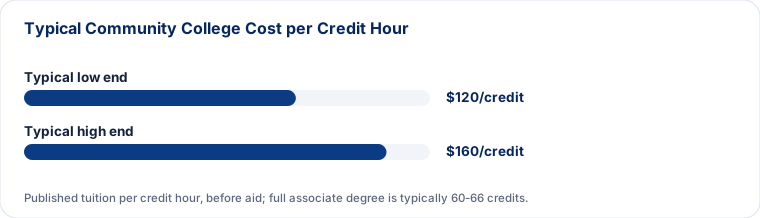
| Cost (published tuition, before aid) | Community colleges average roughly $120-$160 per credit hour in published tuition, making a full associate degree's tuition often several thousand dollars total before aid — substantially less than the same first two years at a four-year institution |
These are national reference ranges, not a quote for any specific school — actual credit requirements, program length, and cost vary by institution, state residency status, and field. Before enrolling, use the specific college's net price calculator (federally required and linked from its financial aid page) to get a personalized cost estimate, and confirm the exact credit count and expected completion time with the program's advisor, since programs within the same credential level can differ by a full semester or more depending on prerequisite requirements and course availability. Part-time enrollment, common among working adults and parents, extends every figure in the table above roughly in proportion to the reduced course load, and many programs cap how few credits a student can take per term while still qualifying as "enrolled" for financial aid purposes — another detail worth confirming directly if part-time study is part of your plan.
How the curriculum is usually structured
Associate degree curricula generally split between general-education requirements (English composition, mathematics, a lab science, social science, and humanities courses — usually 20-30 credits) and major-specific coursework. Transfer-oriented associate degrees (Associate of Arts/Science) are deliberately built to satisfy the first two years of a four-year degree's general-education requirements, often through statewide articulation agreements that guarantee specific credits will transfer to public four-year institutions in the same state. Career-oriented associate degrees (Associate of Applied Science) instead weight coursework toward technical and applied major requirements, sometimes including a clinical or practicum component, and are less commonly designed for further transfer, though many still transfer at least partially.
Who this credential is for
Students entering fields where an associate degree is a recognized, licensable entry point (registered nursing via ADN, for example); students planning to transfer into a four-year program while minimizing early cost; and adult or working students who need a shorter, more affordable first credential.
Just as importantly, this level is often not the right choice when a shorter or longer credential would serve the same underlying goal more efficiently. Before committing, it's worth asking directly: does my target field actually require this specific level, or a different one, for the role I want? Is there a faster path (a certificate or associate degree) that gets me working sooner in a field where experience counts as much as credential level? Or does my target field's licensure requirement mean a shorter credential simply won't qualify me at all, no matter how strong my resume otherwise looks? The program pages on this site note the typical minimum credential and licensure pathway for each of the 50 fields covered here as a starting reference for this question.
Where this fits on the full degree ladder
| Level | Typical credits | Typical full-time duration |
|---|---|---|
| Certificate | 9-45 credits | A few months to about 1 year |
| Associate | 60-66 credits | About 2 years |
| Bachelor's | 120-128 credits | About 4 years |
| Master's | 30-36+ credits (beyond the bachelor's) | 1-3 years, commonly 2 |
| Doctoral | 30-90 credits plus dissertation/clinical training | 3-7+ years beyond the bachelor's or master's |
Each level generally builds on, rather than replaces, the one before it, and most fields have a recognized minimum level required to practice, with additional levels adding depth, specialization, licensure eligibility, or research capability rather than repeating the same content at greater length. Moving up a level is rarely a matter of simply taking more of the same coursework — it usually means a meaningful jump in specialization, independence expected of the student, and, for licensure-track fields, additional legal scope of practice.
Accreditation considerations
Institutional accreditation matters equally at every credential level — federal financial aid, credit transfer, and general credibility all depend on it regardless of whether you're pursuing a certificate or a doctorate. Programmatic accreditation becomes more consequential the further a field is tied to licensure: a certificate in a non-licensed field (project management, for example) may not have or need a specialized programmatic accreditor, while a doctoral program in medicine, law, dentistry, or pharmacy without the field-specific accreditor (LCME/COCA, ABA, CODA, ACPE respectively) is not a credential that leads to licensure at all, regardless of its academic content. See our accreditation guide for the accreditor that applies to your specific field before enrolling at any credential level. As a practical check, search the Department of Education's accredited-institution database and, where relevant, the field-specific accreditor's own program directory for the exact institution and program name — not just the institution's general reputation — before paying a deposit or signing an enrollment agreement.
Financial aid at this level
Associate degree students at accredited institutions are generally eligible for the same federal aid programs as bachelor's students — Pell Grants, federal work-study, and federal loans — prorated to enrollment intensity. Because community college tuition is substantially lower than four-year tuition, a Pell Grant can cover a much larger share (sometimes all) of tuition and fees for eligible students, which is one reason the associate-then-transfer pathway is a common cost-reduction strategy for students planning to eventually earn a bachelor's degree.
Common mistakes at this level
- Assuming an associate degree automatically transfers in full to a four-year program without checking for a formal articulation agreement.
- Choosing a transfer-oriented Associate of Arts/Science when the target field actually requires an Associate of Applied Science, or vice versa.
- Not confirming an ADN nursing program's NCLEX-RN pass rate and clinical placement structure before enrolling, since these vary significantly between programs.
How this looks across different fields
The same credential level plays a different role from field to field. In fields like nursing, an associate degree (ADN) is a genuine, licensable entry point into practice as a registered nurse, while in a field like software engineering, an associate degree is far less commonly the terminal credential employers expect. In fields like medicine, law, dentistry, and pharmacy, the doctoral level is not an optional advanced credential — it is the entry-level practicing credential, with no bachelor's-only path to licensure. In fields like accounting, a bachelor's degree covers the core content, but many states require 150 total credit hours (beyond the standard 120) for CPA licensure, which some students satisfy with a bachelor's-plus-extra-coursework path and others satisfy with a full master's degree. Check each of the 50 program pages on this site for the field-specific licensure and accreditation notes relevant to the associate degree level in that field, since assuming a general rule about credential levels applies uniformly across every field is one of the most common planning mistakes prospective students make.
A realistic example
Consider a student who knows they want to become a registered nurse but is uncertain whether they can afford, or want to commit to, a four-year BSN program right away. An ADN (Associate Degree in Nursing) program, typically about two years and substantially cheaper at a community college, leads directly to NCLEX-RN eligibility and licensed practice as an RN. Many ADN-prepared nurses later complete an RN-to-BSN bridge program, often while working and sometimes with tuition assistance from their employer, rather than delaying entry into the workforce for two additional years up front.
Stacking toward a Bachelor's Degree
Many students treat a associate degree as a deliberate step toward a bachelor's degree, either immediately or after working for a period first. Where a formal articulation or stacking arrangement exists between a specific certificate/associate program and a four-year (or graduate) program, credits transfer automatically or with minimal loss; where no such arrangement exists, transfer credit is evaluated case by case by the receiving institution, and some credits may not transfer at all. Before choosing a associate degree program with the intention of continuing further, ask directly whether it has a formal transfer or stacking agreement with the program you're ultimately aiming for, rather than assuming credits will carry forward.
See our Bachelor's Degree page for what typically comes next.
Frequently asked questions
Is an associate degree enough to start a career?
In some fields (registered nursing via ADN, many technical and applied trades), yes — it's a genuine, licensable entry point. In others, it functions primarily as a transfer credential toward a bachelor's degree. Check the specific field.
Do all associate degree credits transfer to a four-year school?
Not automatically. Many states have formal statewide articulation agreements guaranteeing transfer of specific associate degrees to public four-year institutions, but confirm the specific agreement applies to your intended major and destination school.
Is a community college associate degree lower quality than a university's?
Not inherently — many community college associate programs are taught by qualified faculty and hold the same institutional accreditation standards as four-year institutions. Program quality varies by institution regardless of type, so evaluate specific programs rather than assuming based on institution category.
Can I get a bachelor's-level job with just an associate degree?
In fields where the associate is a recognized licensable credential (registered nursing, several allied health and technical fields), yes. In fields that expect a bachelor's degree as the baseline, an associate degree alone is typically a stepping stone rather than a terminal qualification.
Is it better to start at a community college and transfer, or start at a four-year school directly?
Both are common paths; the community-college-transfer route generally lowers total cost if the transfer plan is executed correctly with a clear articulation agreement, while starting directly at a four-year school can simplify course sequencing and access to four-year-specific resources from day one.
Do community colleges offer the same financial aid as four-year schools?
Yes — accredited community colleges participate in the same federal aid programs (Pell Grants, work-study, federal loans), and many state grant programs also apply, though some state merit programs are restricted to four-year institutions, so check the specific program's eligibility rules.
For how this credential level fits your specific field of interest, see the relevant program page, which notes typical entry-level requirements, accreditation, and career data for that field specifically.
