

What a bachelor's degree actually is
The bachelor's degree is the credential most U.S. career planning is built around, and for good reason — it's the minimum entry point for the largest share of professional, managerial, and licensed roles. This page covers what actually goes into one, what it costs, and when it's genuinely necessary versus when a shorter credential might serve the same goal.
A bachelor's degree is the standard four-year undergraduate credential in the U.S. and the minimum entry requirement for most professional, managerial, and licensed occupations covered on this site. It combines general-education coursework, a major (and often a minor or concentration), and, in many fields, a capstone, internship, or research project in the final year.
The rest of this page covers the practical specifics — typical time and cost, how the curriculum is usually built, who this level tends to fit well, and where it sits relative to the other four credential levels covered on this site. As with every page here, treat the figures below as a well-sourced starting reference, and confirm exact numbers for any specific program directly with that program before enrolling, since real programs vary around these national norms in both directions.

Friendly editorial photography gives long research pages a natural visual pause while the detailed data, sources, tables, and guidance stay central.
Education photo via UnsplashTypical time, credits, and cost
| Factor | Typical range |
|---|---|
| Credit hours | 120-128 credits |
| Time to complete (full-time) | 4 years of full-time study (5-6 years is common for students who transfer, attend part-time, or change majors) |
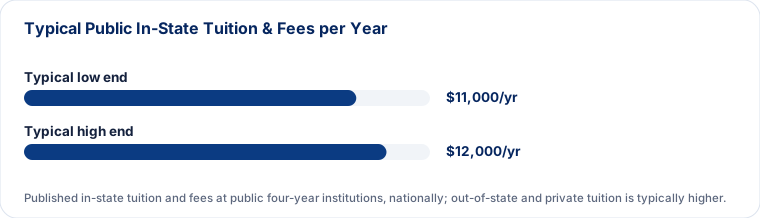
| Cost (published tuition, before aid) | Published in-state tuition and fees at public four-year institutions average roughly $11,000-$12,000 per year nationally, with significant variation by state; out-of-state and private tuition is typically much higher before aid — always compare net price, not sticker price, using each school's net price calculator |
These are national reference ranges, not a quote for any specific school — actual credit requirements, program length, and cost vary by institution, state residency status, and field. Before enrolling, use the specific college's net price calculator (federally required and linked from its financial aid page) to get a personalized cost estimate, and confirm the exact credit count and expected completion time with the program's advisor, since programs within the same credential level can differ by a full semester or more depending on prerequisite requirements and course availability. Part-time enrollment, common among working adults and parents, extends every figure in the table above roughly in proportion to the reduced course load, and many programs cap how few credits a student can take per term while still qualifying as "enrolled" for financial aid purposes — another detail worth confirming directly if part-time study is part of your plan.
How the curriculum is usually structured
A bachelor's curriculum typically has three layers: general-education requirements (usually 30-45 credits, spanning writing, mathematics, science, humanities, and social science), major requirements (usually 40-60 credits in the specific field), and free electives that fill out the remaining credits — sometimes used for a minor or a second concentration. Most bachelor's programs also include a culminating experience in the senior year: a capstone project, a thesis, a portfolio, or a required internship, depending on the field. Students who enter with transfer credit from an associate degree or AP/dual-enrollment coursework often complete the general-education layer largely before arriving, shortening time to completion accordingly.

Who this credential is for
The majority of students pursuing a professional career that requires a four-year degree as a baseline — most business, engineering, computing, education, and many healthcare and social-science roles.
Just as importantly, this level is often not the right choice when a shorter or longer credential would serve the same underlying goal more efficiently. Before committing, it's worth asking directly: does my target field actually require this specific level, or a different one, for the role I want? Is there a faster path (a certificate or associate degree) that gets me working sooner in a field where experience counts as much as credential level? Or does my target field's licensure requirement mean a shorter credential simply won't qualify me at all, no matter how strong my resume otherwise looks? The program pages on this site note the typical minimum credential and licensure pathway for each of the 50 fields covered here as a starting reference for this question.
Where this fits on the full degree ladder
| Level | Typical credits | Typical full-time duration |
|---|---|---|
| Certificate | 9-45 credits | A few months to about 1 year |
| Associate | 60-66 credits | About 2 years |
| Bachelor's | 120-128 credits | About 4 years |
| Master's | 30-36+ credits (beyond the bachelor's) | 1-3 years, commonly 2 |
| Doctoral | 30-90 credits plus dissertation/clinical training | 3-7+ years beyond the bachelor's or master's |
Each level generally builds on, rather than replaces, the one before it, and most fields have a recognized minimum level required to practice, with additional levels adding depth, specialization, licensure eligibility, or research capability rather than repeating the same content at greater length. Moving up a level is rarely a matter of simply taking more of the same coursework — it usually means a meaningful jump in specialization, independence expected of the student, and, for licensure-track fields, additional legal scope of practice.
Accreditation considerations
Institutional accreditation matters equally at every credential level — federal financial aid, credit transfer, and general credibility all depend on it regardless of whether you're pursuing a certificate or a doctorate. Programmatic accreditation becomes more consequential the further a field is tied to licensure: a certificate in a non-licensed field (project management, for example) may not have or need a specialized programmatic accreditor, while a doctoral program in medicine, law, dentistry, or pharmacy without the field-specific accreditor (LCME/COCA, ABA, CODA, ACPE respectively) is not a credential that leads to licensure at all, regardless of its academic content. See our accreditation guide for the accreditor that applies to your specific field before enrolling at any credential level. As a practical check, search the Department of Education's accredited-institution database and, where relevant, the field-specific accreditor's own program directory for the exact institution and program name — not just the institution's general reputation — before paying a deposit or signing an enrollment agreement.
Financial aid at this level
Bachelor's students have access to the broadest range of aid: Pell Grants (need-based), federal Direct Subsidized and Unsubsidized Loans, federal work-study, state grant programs (see each state page on this site), and institutional scholarships and grants from the college itself. Because Pell Grant eligibility is capped at the equivalent of 12 full-time semesters (Lifetime Eligibility Used), students who take longer than the standard four years, particularly after starting and stopping enrollment, should track remaining eligibility through their financial aid office.
Common mistakes at this level
- Choosing a major primarily because it sounds impressive rather than checking the accreditation, curriculum, and career outcomes relevant to your actual goals.
- Underestimating total cost by focusing on the advertised four-year timeline when the realistic completion time, including any changes of major, is closer to five or six years.
- Not researching whether your intended field requires a specific accredited major (nursing, engineering, accounting-adjacent CPA tracks) versus accepting any related bachelor's degree.
How this looks across different fields
The same credential level plays a different role from field to field. In fields like nursing, an associate degree (ADN) is a genuine, licensable entry point into practice as a registered nurse, while in a field like software engineering, an associate degree is far less commonly the terminal credential employers expect. In fields like medicine, law, dentistry, and pharmacy, the doctoral level is not an optional advanced credential — it is the entry-level practicing credential, with no bachelor's-only path to licensure. In fields like accounting, a bachelor's degree covers the core content, but many states require 150 total credit hours (beyond the standard 120) for CPA licensure, which some students satisfy with a bachelor's-plus-extra-coursework path and others satisfy with a full master's degree. Check each of the 50 program pages on this site for the field-specific licensure and accreditation notes relevant to the bachelor's degree level in that field, since assuming a general rule about credential levels applies uniformly across every field is one of the most common planning mistakes prospective students make.
A realistic example
Consider a student choosing between two paths into business: a direct four-year business administration bachelor's degree, or two years at a community college followed by transfer into the same four-year program's junior year. Both end at the same bachelor's degree, but the transfer path can meaningfully lower total cost if the receiving four-year program has a clear articulation agreement with the community college — the deciding factor is less about which path is "better" in the abstract and more about confirming the specific transfer credits will actually apply before committing to either route.
Stacking toward a Master's Degree
Many students treat a bachelor's degree as a deliberate step toward a master's degree, either immediately or after working for a period first. Where a formal articulation or stacking arrangement exists between a specific certificate/associate program and a four-year (or graduate) program, credits transfer automatically or with minimal loss; where no such arrangement exists, transfer credit is evaluated case by case by the receiving institution, and some credits may not transfer at all. Before choosing a bachelor's degree program with the intention of continuing further, ask directly whether it has a formal transfer or stacking agreement with the program you're ultimately aiming for, rather than assuming credits will carry forward.
See our Master's Degree page for what typically comes next.
Frequently asked questions
How long does a bachelor's degree really take?
The standard published length is 4 years, but NCES data has long shown a majority of bachelor's students take longer — 5 to 6 years is common, often due to changing majors, part-time enrollment, or transfer credit loss.
Do I need a bachelor's degree specifically in the field I want to work in?
Not always. Many employers hire based on demonstrated skills and a bachelor's degree in any field, particularly outside licensed professions; some fields (nursing, engineering, accounting) do require a specific or accredited major, so check field-specific requirements.
Is a bachelor's degree still worth it?
On average, BLS and Census data consistently show a substantial lifetime earnings gap favoring bachelor's degree holders over those with a high school diploma alone, though outcomes vary significantly by field, institution cost, and individual circumstances — see our careers page for how to evaluate this for a specific field rather than relying on the national average alone.
Can I switch majors without extending my timeline?
It depends heavily on when you switch and how much your prior coursework overlaps with the new major's requirements; switching early (freshman or sophomore year) is far less likely to add time than switching in the junior or senior year.
Do employers care which specific college granted my bachelor's degree?
For most fields, institutional accreditation and relevant experience matter more broadly than the specific college's name recognition, though highly selective employers and certain competitive fields do weight institutional reputation more heavily — this varies enough by field and employer that it's worth researching norms in your specific target industry.
Is a double major worth the extra time and cost?
It depends on how directly the second major supports your goals; a genuinely complementary pairing (business and a technical field, for example) can strengthen a resume, while two loosely related majors mainly add time without a clear corresponding benefit. Weigh it against a minor or a relevant internship, which often provide similar signal at lower cost.
For how this credential level fits your specific field of interest, see the relevant program page, which notes typical entry-level requirements, accreditation, and career data for that field specifically.
