
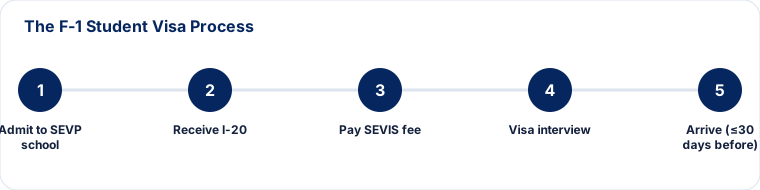
Overview of the F-1 student visa process
International students pursuing a full-time academic degree in the United States generally need an F-1 student visa, issued by the U.S. Department of State, and must attend a school certified by the Student and Exchange Visitor Program (SEVP), part of the Department of Homeland Security. The process has several sequential steps — admission to a SEVP-certified school, issuance of the Form I-20, payment of the SEVIS I-901 fee, a visa application and interview at a U.S. embassy or consulate, and arrival in the U.S. no earlier than 30 days before the program start date — and each step depends on completing the one before it, so realistic planning generally starts eight to twelve months ahead of an intended enrollment date. A separate visa category, M-1, applies to vocational and non-academic study, and J-1 applies to exchange visitor programs; this page focuses on the F-1 process, which covers the large majority of international degree-seeking students.

Friendly editorial photography gives long research pages a natural visual pause while the detailed data, sources, tables, and guidance stay central.
Education photo via UnsplashChoosing a SEVP-certified school and program
Only schools certified by SEVP may issue the Form I-20 required for an F-1 visa, and certification is a separate status from institutional accreditation — a school can be accredited without being SEVP-certified, though the reverse is rare. The Department of Homeland Security's Study in the States website maintains a searchable list of SEVP-certified schools, and confirming certification directly there, rather than relying solely on a school's own marketing claims, is a reasonable first step. Beyond certification, international applicants should confirm the same accreditation and programmatic-accreditation facts that matter for any student (see our accreditation guide), since a foreign student who completes a degree from an institution lacking proper accreditation faces the same downstream problems with licensure, credit transfer, and employer recognition as a domestic student would.
English proficiency and standardized testing
Most U.S. degree programs require proof of English proficiency from applicants whose prior education was not conducted in English, most commonly through TOEFL iBT, IELTS Academic, or Duolingo English Test scores, though required minimum scores vary by institution and by program (graduate programs often set higher thresholds than undergraduate ones). Some universities waive this requirement for applicants who completed a certain number of years of schooling in an English-medium curriculum, or offer conditional admission paired with an intensive English program for applicants who fall just short of the required score. Standardized academic admissions tests (SAT or ACT for undergraduate, GRE or GMAT for many graduate programs) may also be required or recommended depending on the program; test-optional policies have become more common at the undergraduate level in recent years but vary by institution, so confirm current requirements directly with each program.
The I-20, SEVIS fee, and financial documentation
After admission, a SEVP-certified school issues Form I-20, "Certificate of Eligibility for Nonimmigrant Student Status," which is required to pay the SEVIS I-901 fee and to apply for the visa. To issue the I-20, schools require documented proof of sufficient funds to cover at least the first year's cost of attendance (tuition, fees, and living expenses), typically through bank statements, an official financial sponsor letter, or scholarship/assistantship award letters, and some schools require this documentation to cover the full expected program length rather than just the first year. Because U.S. federal financial aid (Pell Grants, federal loans) is generally not available to international students, financing typically comes from personal or family funds, a scholarship from the U.S. institution or an external source, an assistantship (common in graduate programs), or a loan from a lender in the student's home country or a U.S.-based international student loan program that does not require a U.S. cosigner — though these often carry higher interest rates than domestic federal loans.
The visa application and interview
With the I-20 and SEVIS fee receipt in hand, applicants complete the DS-160 online nonimmigrant visa application and schedule a visa interview at a U.S. embassy or consulate, generally in their home country. Wait times for interview appointments vary significantly by location and season, and can range from a few days to several months, which is one of the main reasons early planning matters. At the interview, consular officers commonly ask about the applicant's specific program of study, ability to pay for it, ties to their home country, and post-graduation plans; officers are evaluating, among other things, whether the applicant intends to return home after completing the program, since F-1 is a nonimmigrant visa category. Required documents typically include the I-20, SEVIS fee receipt, DS-160 confirmation page, a valid passport, a passport photo, and financial and academic supporting documents; specific requirements vary by consulate, so check the specific U.S. embassy or consulate's website for the applicant's location before the appointment.
Arrival, orientation, and maintaining status
F-1 students may enter the U.S. up to 30 days before their program's start date listed on the I-20. Nearly all SEVP-certified schools require new international students to attend an international student orientation, which typically covers the practical mechanics of maintaining legal status: enrolling full-time each term (with limited, school-approved exceptions), keeping the I-20 updated with the school's Designated School Official (DSO) if personal or program details change, and understanding the rules around employment, travel, and program extensions. Falling out of status — commonly by dropping below full-time enrollment without authorization, working without authorization, or letting the I-20 lapse — can jeopardize a student's ability to remain in or return to the U.S., so international students should treat their DSO as a primary point of contact for any change in circumstances rather than assuming a situation will resolve itself.
On-campus work, CPT, and OPT
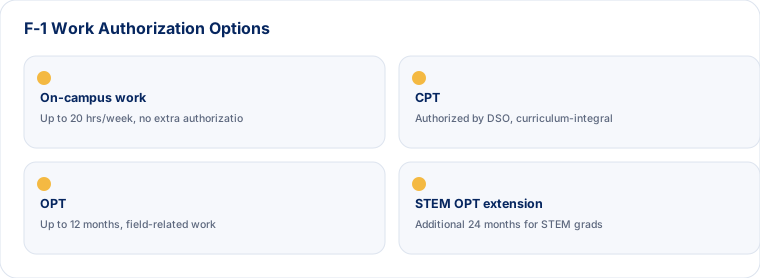
F-1 students may generally work on campus up to 20 hours per week while school is in session (full-time during official breaks), without separate authorization beyond the F-1 status itself. Off-campus work requires specific authorization: Curricular Practical Training (CPT) allows work directly related to a student's field of study that is integral to the curriculum (such as a required internship), authorized by the DSO before the work begins. Optional Practical Training (OPT) allows up to 12 months of work authorization related to the student's field of study, usable either during or after the academic program, and STEM-designated degree programs may qualify graduates for a 24-month OPT extension beyond the initial 12 months, for a total of up to 36 months, subject to specific employer and reporting requirements. Because these authorizations have specific application windows, eligibility rules, and processing times through U.S. Citizenship and Immigration Services (USCIS), students should begin researching OPT eligibility and application timing at least a full semester before they intend to use it.
Paying for a U.S. degree as an international student
Because most federal and state financial aid is restricted to U.S. citizens and eligible noncitizens, international students should expect to rely primarily on personal and family resources, need- or merit-based aid offered directly by the U.S. institution (many universities offer at least some international scholarships or tuition discounts), external scholarships from foundations or the student's home government, and, for graduate students, teaching or research assistantships that often include a tuition waiver and stipend. Some private lenders offer international student loans without requiring a U.S. citizen cosigner, generally at higher interest rates than domestic federal loans; compare total repayment cost carefully, including currency-exchange risk if income after graduation will be earned in a different currency than the loan.
Bringing a spouse or children (F-2 status)
F-1 students with a spouse or unmarried children under 21 may bring them to the U.S. under F-2 dependent status, which requires its own supporting I-20 issued by the same school and its own visa application. F-2 spouses are generally not permitted to work in the U.S. under standard F-2 status, though they may enroll in study that is avocational or recreational in nature; a spouse wishing to pursue a full degree program typically needs to change to their own F-1 status rather than remaining an F-2 dependent. F-2 children may enroll in U.S. public or private K-12 schools. Because F-2 status depends entirely on the F-1 student maintaining valid status, any lapse in the primary student's status affects dependents as well, which is one more reason to treat status maintenance as a priority throughout the program.
Cultural adjustment and campus support services
Adjusting to a new academic system, language environment, and daily culture is a real part of the international student experience, separate from the visa paperwork itself. Most SEVP-certified schools with a meaningful international enrollment maintain a dedicated international student services office that goes beyond visa compliance to offer arrival support (airport pickup programs, initial housing guidance), cultural adjustment programming, peer mentor or "buddy" programs pairing new international students with current ones, and connections to student organizations organized around shared nationality, region, or language. Academic culture also varies: U.S. classrooms often expect more class participation and independent, discussion-based engagement than some students are used to, and academic integrity standards (particularly around collaboration and citation) are usually explained explicitly during orientation but are worth asking about directly if anything is unclear, since violations can carry serious academic and, in some cases, immigration consequences. Health insurance is typically mandatory for international students, either through a school-sponsored plan or an approved outside plan meeting the school's minimum coverage requirements; confirm the specific requirement and cost with the school before arrival, since it is usually a required, non-optional cost of attendance.
A realistic timeline
| When | Action |
|---|---|
| 8-12 months before enrollment | Research SEVP-certified schools and programs; take required English proficiency and admissions tests. |
| 6-9 months before | Apply for admission; gather financial documentation for the I-20. |
| After admission | Receive the I-20; pay the SEVIS I-901 fee; complete the DS-160. |
| As soon as possible after that | Schedule the visa interview — appointment availability varies widely by location and season. |
| Up to 30 days before the program start date | Travel to the U.S.; attend international student orientation. |
| Throughout enrollment | Maintain full-time status; keep the DSO informed of any changes; plan CPT/OPT applications a semester ahead if relevant. |
Frequently asked questions
Can international students get U.S. federal financial aid?
Generally no. Federal Pell Grants and federal student loans are restricted to U.S. citizens and eligible noncitizens. Some institutional scholarships, assistantships, and private international student loans are available instead.
Can F-1 students work off campus?
Only with specific authorization — Curricular Practical Training (CPT) for work integral to the curriculum, or Optional Practical Training (OPT) for work related to the field of study, both requiring formal authorization before work begins.
What happens if my visa application is delayed?
Program start dates on the I-20 may need to be deferred to a later term if a visa cannot be obtained in time; contact the school's international student office as soon as a delay seems likely, since many schools have a process for deferring admission without restarting the full application.
Do I need a specific bank account to prove funding?
Not necessarily a specific type, but documentation must clearly show sufficient funds are available and, in many cases, liquid and accessible — check the specific school's I-20 financial documentation requirements, since format expectations vary by institution.
Can I transfer between U.S. schools while on an F-1 visa?
Yes, through a SEVIS transfer process coordinated between the current and new school's DSOs, provided the student maintains valid status throughout. Confirm the specific transfer procedure and timing with both schools' international student offices before withdrawing from the current one.
