
Why we don't publish a numbered top-10 list
Most "best colleges for X" content on the internet presents a numbered list of named institutions, often with little visible explanation of the underlying data or methodology. We considered that format and deliberately chose not to use it, for a specific reason: responsibly ranking individual, named institutions against each other requires continuously verified, institution-specific data — current accreditation status, program-level outcomes, cost, and student support metrics — that changes constantly and that we do not independently collect and re-verify on an ongoing basis. Publishing a ranked list without that underlying verification would mean asking you to trust an ordering we can't actually stand behind, which runs against the accuracy commitment described on our About page. It would also mean implicitly ranking real institutions — and by extension the students and faculty at them — against each other using data we have not independently confirmed is current, which is a level of confidence we are not willing to overstate just because a numbered list is a familiar and easy-to-scan format for readers.

Friendly editorial photography gives long research pages a natural visual pause while the detailed data, sources, tables, and guidance stay central.
Education photo via UnsplashWhat "rankings" pages on this site actually contain instead
Each "Best [Field] Programs" page on this site is built as an evaluation guide rather than a numbered ranking: the specific criteria that actually distinguish strong programs in that field (the programmatic accreditor to check, typical strong-program markers like clinical placement guarantees or licensure pass rates, curriculum depth signals, and career outcome data), organized so you can apply them yourself to any specific school you're considering. This gives you something more durable than a snapshot ranking that may already be outdated by the time you read it — a reusable evaluation checklist you can apply consistently across every school on your own shortlist, updated as your own priorities shift rather than fixed to whatever weighting a publisher chose on a specific date. It also means the same underlying framework works whether you're comparing two well-known flagship universities or two smaller regional programs that a traditional prestige-weighted ranking would rarely feature at all.
The methodology problem with most college rankings
Published college rankings, even from well-known outlets, generally combine multiple weighted factors (selectivity, reputation surveys, financial resources, alumni giving, graduation rates) into a single composite score, and the specific weighting of those factors is a subjective editorial choice that can swing rankings significantly with only modest changes to the formula. Reputation survey components in particular can lag actual program quality by years, since they rely on other academics' impressions formed over a career rather than current, verifiable outcomes data about a specific program today. None of this makes rankings useless, but it does mean a ranking answers a specific, narrow question ("how does this school score on this particular weighted formula") rather than the more useful question most readers actually have ("is this specific program, for my specific goals, a good choice"). Selectivity and financial-resources components in particular tend to reward institutional wealth and applicant volume more than they measure teaching quality or student outcomes directly, which is worth keeping in mind when a highly selective school and a less selective one with strong licensure pass rates or job placement in your specific field both appear on your shortlist.
How our evaluation guides are structured
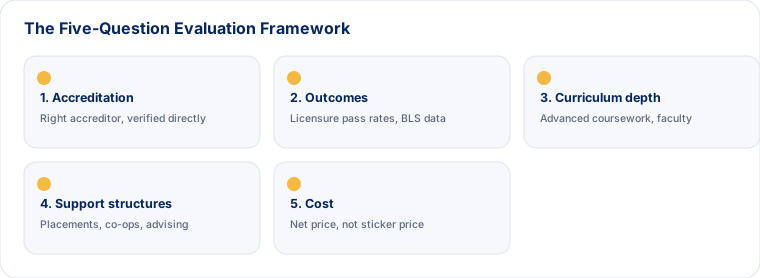
Each field-specific evaluation guide is organized around the same five questions, applied to that field's specific accreditation and licensure landscape: What programmatic accreditor should exist for this field, and does the accreditor's own directory show the specific program as currently accredited? What does the field's outcomes data typically look like (licensure or certification pass rates where applicable, or BLS-sourced career data where there is no licensing exam)? What curriculum depth signals distinguish a well-built program — specific advanced coursework, faculty research areas, lab or clinical facilities — from a minimally compliant one? What support structures matter most for this field specifically (guaranteed clinical placements in healthcare fields, co-op programs in engineering, career services quality in business and communications fields)? And what does realistic total cost and time to completion look like once net price, not sticker price, is used? Applying these five questions consistently to every school on your shortlist produces a comparison that's specific to you, rather than a generic score computed for an average applicant you may not resemble, and it travels well across degree levels — the same five questions apply whether you're evaluating a certificate program or a doctoral one, even though the specific answers look very different at each level.
A brief illustration of why rankings shift
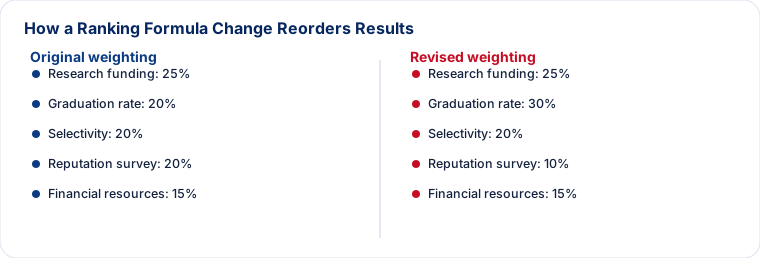
Consider a hypothetical ranking that weights research funding at 25%, graduation rate at 20%, selectivity at 20%, reputation survey at 20%, and financial resources at 15%. A publisher revising that formula to weight reputation survey at only 10% and graduation rate at 30% — a defensible methodological choice either way — can reorder the list substantially without any actual change at the schools themselves. This isn't a criticism of any specific publisher; it's simply how composite scoring works, and it's the reason two reputable rankings of the same field can disagree meaningfully on ordering while both being methodologically sound by their own stated criteria. Understanding this mechanic is what allows you to use rankings as one input among several rather than as a final verdict, and it's also why a school that drops several spots in a given year hasn't necessarily gotten worse — the formula, not the school, may be what actually changed.
How to use published rankings responsibly
- Check the methodology before the list. A ranking's published methodology page tells you what's actually being measured, and whether those factors matter for your specific situation (a research-reputation-heavy ranking matters less if you're evaluating a teaching-focused associate program, for example).
- Treat rankings as a discovery tool, not a decision tool. A ranking is useful for surfacing schools you might not have otherwise considered; the decision itself should rest on the criteria in our comparison framework applied to your specific circumstances.
- Cross-reference multiple rankings. A school that ranks well across several independently produced rankings with different methodologies is a stronger signal than a single ranking alone.
- Verify the underlying facts yourself. Accreditation status, licensure pass rates, and net price are independently verifiable through primary sources regardless of what any ranking claims — see our accreditation guide and financial aid guide.
- Watch for outdated data presented as current. Some ranking content online is not refreshed annually even when it appears to be; check the publication or last-updated date before trusting a specific number.
- Be skeptical of "sponsored" or "featured" placements mixed into ranking content without clear disclosure — legitimate rankings clearly separate editorial ranking methodology from any paid placement.
Browse evaluation guides by field
Each link below applies the same five-question framework described above to a specific field, with the accreditor, outcomes data, and curriculum signals relevant to that field named directly rather than left generic, so you can jump straight to the criteria that matter for the subject you're actually researching.
Best Accounting Programs · Best Aerospace Engineering Programs · Best Anthropology Programs · Best Architecture Programs · Best Artificial Intelligence Programs · Best Biochemistry Programs · Best Biology Programs · Best Biomedical Engineering Programs · Best Business Administration Programs · Best Chemical Engineering Programs · Best Chemistry Programs · Best Civil Engineering Programs · Best Communications Programs · Best Computer Engineering Programs · Best Computer Science Programs · Best Criminal Justice Programs · Best Cybersecurity Programs · Best Data Analytics Programs · Best Data Science Programs · Best Dentistry Programs · Best Economics Programs · Best Education Programs · Best Electrical Engineering Programs · Best English Programs · Best Environmental Science Programs · Best Finance Programs · Best Graphic Design Programs · Best Healthcare Administration Programs · Best History Programs · Best Hospitality Management Programs · Best Human Resources Programs · Best Information Systems Programs · Best International Relations Programs · Best Journalism Programs · Best Law Programs · Best Marketing Programs · Best Mathematics Programs · Best Mechanical Engineering Programs · Best Medicine Programs · Best Music Programs · Best Nursing Programs · Best Nutrition Programs · Best Pharmacy Programs · Best Philosophy Programs · Best Physics Programs · Best Political Science Programs · Best Psychology Programs · Best Public Health Programs · Best Social Work Programs · Best Software Engineering Programs
Frequently asked questions
Does this mean rankings are worthless?
No — they're a legitimate discovery and cross-reference tool. The issue is treating a single ranking's ordering as a definitive, current, individually-verified judgment about a specific program, which even the ranking organizations themselves generally don't claim.
Why do other sites publish numbered rankings if the methodology is subjective?
Numbered lists are a familiar, easy-to-scan format that performs well with readers, and many organizations do disclose their methodology transparently even though the underlying weighting choices remain a judgment call regardless of how much detail is published about them. We chose a different format because our specific concern was maintaining continuously verified, institution-specific data at the scale of hundreds of individual schools, not a general objection to all ranking methodology.
Where can I find well-known, methodologically transparent rankings?
Look for rankings that publish their full methodology, including specific factor weights and data sources, and that update on a clear, disclosed schedule — check the "methodology" or "about our rankings" page most ranking publishers maintain before trusting the list itself, and be cautious of any ranking that doesn't publish one at all.
Will you add specific institution rankings in the future?
If we build the continuously verified, institution-specific data infrastructure needed to responsibly maintain one, we would consider it — see our About page for how we think about this tradeoff.
Are "best value" rankings more trustworthy than general prestige rankings?
Value-focused rankings (weighting cost and earnings outcomes more heavily than reputation) tend to answer a more directly useful question for most students, but they carry the same methodological caveat: check exactly how "value" is defined and weighted before assuming it matches what matters most to you specifically, since "value" can be constructed in materially different ways from one publisher to the next.
How do I know if a program is strong if I can't rely on a ranking?
Use the five-question framework above (accreditation status, outcomes data, curriculum depth, support structures, real cost) applied directly to the specific programs on your shortlist, cross-referenced with our comparison framework — this produces a more personalized and more current answer than any single external ranking can.
Whichever approach you take — cross-referencing published rankings, applying our field-specific evaluation guides, or both — the underlying goal is the same: making sure the final decision rests on verifiable, current, and personally relevant information rather than on a single number that may not mean what it appears to mean once you understand how it was actually calculated.
How often should I redo this evaluation?
Revisit it whenever your shortlist changes, or whenever a meaningful amount of time has passed since you last checked accreditation status and outcomes data for a specific program. Both can change from one academic year to the next in ways a one-time check will not catch, and a program that cleared this framework a year ago is worth re-verifying rather than assumed to still hold current status today.
