
Overview
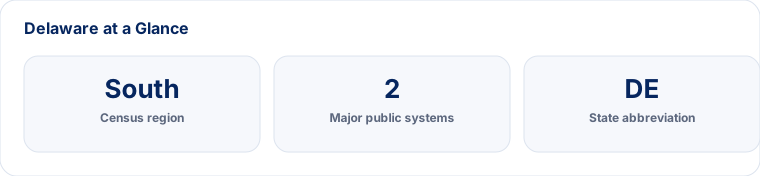
This page is a starting framework for researching colleges and degree programs in Delaware: the state's major public options, how state-specific financial aid works here, and what to verify before committing to a specific school — rather than marketing claims from any single institution. Delaware is part of the U.S. Census Bureau's South region — a region with a large number of public university systems and a fast-growing higher-education population, with tuition and state aid structures that vary significantly from one state in the region to the next. The state's capital is Dover, and Wilmington is its largest city, which is often (though not always) where the state's largest concentration of higher-education options is located.
Every field and degree level covered on this site can be researched two ways: generally (see our full programs index and degree-level guide) or with Delaware-specific context layered on top, which is what this page and its linked sub-pages provide — state financial aid, the state's public university and community college landscape, and the specific higher-education agency that governs aid and oversight in Delaware.

Friendly editorial photography gives long research pages a natural visual pause while the detailed data, sources, tables, and guidance stay central.
Education photo via UnsplashPublic university options in Delaware
Among Delaware's public higher-education options, University of Delaware and Delaware State University are generally the most recognized starting points, though many students find a better fit at a smaller regional public university, a community college, or a private institution once they compare actual program offerings, cost, and format against their specific goals. Public universities typically offer the lowest published tuition for state residents, though private and out-of-state options can sometimes come out competitive or even lower once institutional aid is factored into net price — always compare net price, not sticker price, across every option using each school's net price calculator.
Within a state university system, campuses can differ substantially in size, program offerings, and selectivity even when they share a system name, so treat "the state university system" as a starting point for research rather than a single undifferentiated option — confirm which specific campus offers the specific program and degree level you're after.
Community colleges & the associate-degree pathway
Most states, Delaware included, maintain a network of public community colleges offering associate degrees and certificates at substantially lower published tuition than four-year institutions — often a fraction of the per-credit cost of a public university's tuition. For students planning to transfer, confirm whether a specific community college program has a formal articulation or transfer agreement with a specific four-year institution in Delaware, since an informal assumption that credits will transfer smoothly can turn into lost time and money if it turns out otherwise. See our associate degree guide for more on how the transfer-oriented and terminal-applied associate tracks differ.
Explore education across a> / Delaware
Use this statewide map for geographic context while comparing colleges, degree programs, and education options in Delaware.
This is a statewide research map, not a campus-location claim. Individual institution locations should be confirmed directly with the institution.
State financial aid in Delaware
Delaware's primary state financial aid program is the Delaware Scholarship Incentive Program / SEED Scholarship, run through the Delaware Higher Education Office. This is separate from federal aid (FAFSA, Pell Grants, federal loans — see our financial aid guide) and typically requires its own application steps and deadlines, which the Delaware Higher Education Office publishes and updates; always confirm current eligibility and award figures directly with that agency rather than assuming a prior year's numbers still apply.
The general federal aid process is the same regardless of which state you live in: file the FAFSA as early as possible after it opens each year, since some aid (state aid in particular) is awarded on a first-come, first-served basis until funds run out, not purely on financial need. See our full financial aid guide for how the FAFSA process, the Expected Family Contribution / Student Aid Index, and the difference between grants, work-study, and loans all fit together nationally, then layer Delaware-specific deadlines and requirements from the Delaware Higher Education Office on top.
Accreditation to verify
Regardless of which specific school in Delaware you're considering, confirm both its institutional accreditation (through one of the regional/national accreditors recognized by the U.S. Department of Education) and, where relevant to your specific field, its programmatic accreditation (a subject-specific accreditor like ABET for engineering or CCNE/ACEN for nursing). A short, repeatable verification process:
- Search the accreditor's own program directory for the specific institution and program name.
- Cross-check the institution's overall accreditation status in the U.S. Department of Education's Database of Accredited Postsecondary Institutions and Programs (ope.ed.gov/dapip).
- Ask the program directly for its current accreditation status in writing if you can't find it published, and be wary if a program is vague or evasive about naming its accreditor.
- Recheck accreditation status close to enrollment, since status can change between when you first research a program and when you actually enroll.
See our full accreditation guide for how institutional and programmatic accreditation work together, and why the distinction matters for financial aid eligibility as well as licensure.
Residency, tuition, and out-of-state considerations
In-state tuition at public institutions is typically reserved for students who can document residency in Delaware for a defined period (commonly 12 months) before enrollment, and residency rules can be more restrictive than simply "living there" — confirm the specific requirements directly with any public institution you're considering, since they vary by school and can affect your total cost substantially. Some states participate in regional tuition-reciprocity compacts that let residents of neighboring states pay reduced, non-resident tuition at participating institutions; ask a specific school's admissions or financial aid office whether Delaware participates in any such compact relevant to your situation, since these arrangements are school- and program-specific rather than universal.
Browse programs available in Delaware
Every field covered on this site has a Delaware-specific research page layering state financial aid, public university options, and licensing-board context on top of the national curriculum, accreditation, and career framework. Browse by field below, or start from our full national programs index if you'd like the general framework first.
Accounting in Delaware · Aerospace Engineering in Delaware · Anthropology in Delaware · Architecture in Delaware · Artificial Intelligence in Delaware · Biochemistry in Delaware · Biology in Delaware · Biomedical Engineering in Delaware · Business Administration in Delaware · Chemical Engineering in Delaware · Chemistry in Delaware · Civil Engineering in Delaware · Communications in Delaware · Computer Engineering in Delaware · Computer Science in Delaware · Criminal Justice in Delaware · Cybersecurity in Delaware · Data Analytics in Delaware · Data Science in Delaware · Dentistry in Delaware · Economics in Delaware · Education in Delaware · Electrical Engineering in Delaware · English in Delaware · Environmental Science in Delaware · Finance in Delaware · Graphic Design in Delaware · Healthcare Administration in Delaware · History in Delaware · Hospitality Management in Delaware · Human Resources in Delaware · Information Systems in Delaware · International Relations in Delaware · Journalism in Delaware · Law in Delaware · Marketing in Delaware · Mathematics in Delaware · Mechanical Engineering in Delaware · Medicine in Delaware · Music in Delaware · Nursing in Delaware · Nutrition in Delaware · Pharmacy in Delaware · Philosophy in Delaware · Physics in Delaware · Political Science in Delaware · Psychology in Delaware · Public Health in Delaware · Social Work in Delaware · Software Engineering in Delaware
Browse by degree level in Delaware
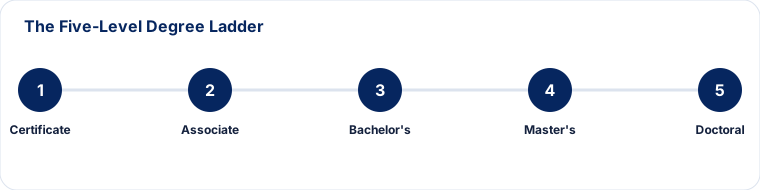
Each degree level also has a Delaware-specific page covering typical cost, admission requirements, and where in the state that level is most commonly earned (community colleges for certificates and associate degrees; four-year public and private institutions for bachelor's and above).
Certificate in Delaware · Associate Degree in Delaware · Bachelor's Degree in Delaware · Master's Degree in Delaware · Doctoral Degree in Delaware
Online & out-of-state enrollment
If you're considering an online program based outside Delaware, confirm the institution is authorized to enroll students residing in Delaware — most institutions handle this through NC-SARA (the National Council for State Authorization Reciprocity Agreements), a reciprocity agreement most states participate in, though a small number of programs (particularly those leading to licensure) may have additional state-specific authorization requirements. See our locations and state authorization guide for how this works in more detail, and confirm current authorization status directly with any specific out-of-state program before enrolling, since authorization can change from year to year.
How to evaluate a specific school in Delaware
- Confirm institutional and (where relevant to your field) programmatic accreditation directly, using the steps above.
- Confirm in-state residency requirements and current published tuition if you're a Delaware resident, or authorization/reciprocity status if you're not.
- Check the Delaware Scholarship Incentive Program / SEED Scholarship and other Delaware-specific aid through the Delaware Higher Education Office alongside federal aid via the FAFSA.
- Compare net price (not published tuition) using each school's net price calculator.
- Use our comparison framework to weigh finalists side by side across accreditation, cost, curriculum, outcomes, and support.
- Where your field has a state licensing board, confirm the specific program meets that board's current education requirements before enrolling.
Frequently asked questions
Do I have to attend college in Delaware if I live there?
No — plenty of students attend college out of state, whether for a specific program, a scholarship, or personal preference. Attending in-state is generally the lowest-cost public option due to in-state tuition rates, but it isn't a requirement, and some out-of-state or private options can be competitive on net price once institutional aid is factored in.
How do I find the exact deadline for Delaware's state financial aid?
Check directly with the Delaware Higher Education Office, since state aid deadlines are set and updated independently of the federal FAFSA deadline and can change from year to year.
Are community colleges in Delaware a good option?
For many students, yes — particularly for the first two years of a bachelor's-bound path (if a solid transfer/articulation agreement exists with a target four-year school) or for fields where an associate degree is a genuine, licensable entry point, like registered nursing. See our associate degree guide for more.
Can I get Delaware state aid if I attend school out of state?
This varies significantly by state and by the specific aid program — some state grant programs are restricted to in-state institutions only, while others (including some regional reciprocity arrangements) extend further. Confirm directly with the Delaware Higher Education Office.
What's the difference between the state's flagship university and its other public campuses?
"Flagship" generally refers to a state's largest, most research-intensive, or most historically prominent public university, but it isn't an official designation with a fixed meaning, and other campuses in the same system may be a stronger fit for a specific program, cost profile, or size preference. Compare specific programs directly rather than assuming the flagship label alone signals the best fit for you.
Does this page cover every college in Delaware?
No — this page and its linked sub-pages provide a state-specific research framework and name major public options as a starting reference point, not an exhaustive directory of every institution in Delaware. Use the framework here to evaluate whichever specific schools you're actually considering, including ones not named on this page.
How is this page different from the national programs and degree-level guides?
The national pages (our programs index and degree-level guide) describe curriculum, accreditation, licensure, and BLS-sourced career data that hold regardless of where you attend school. This page and its linked Delaware-specific sub-pages layer state-specific facts on top of that same framework: the Delaware Scholarship Incentive Program / SEED Scholarship, the Delaware Higher Education Office, Delaware's major public institutions, and residency and reciprocity considerations specific to this state. Neither replaces the other — a thorough search typically starts with the national framework for a given field or level, then narrows to the state-specific page for the practical details of actually enrolling as a Delaware resident or in a Delaware-based program.
