

What a doctoral degree actually is
"Doctoral degree" is really two different credentials wearing the same label — a research PhD built around original scholarship, and a professional doctorate (MD, JD, PharmD, DDS, DNP) that is simply the standard practicing credential for a licensed field. Confusing the two leads to very different, and sometimes very wrong, expectations about time, cost, and purpose.
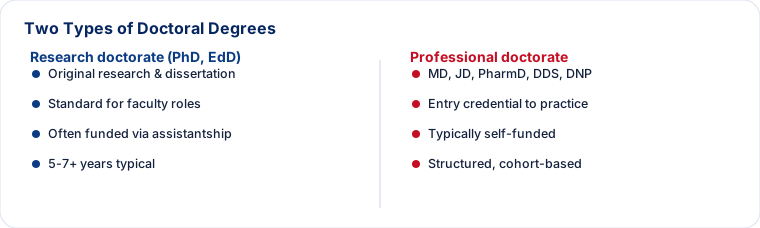
"Doctoral degree" covers two meaningfully different categories. A research doctorate (PhD, EdD) trains a graduate to conduct original research and typically culminates in a dissertation; it is the standard credential for university faculty and many senior research roles. A professional doctorate (MD, DO, JD, PharmD, DDS/DMD, DNP) is the entry-level practicing credential for a licensed profession — the primary example, not an optional add-on, in fields like medicine, law, dentistry, and pharmacy.
The rest of this page covers the practical specifics — typical time and cost, how the curriculum is usually built, who this level tends to fit well, and where it sits relative to the other four credential levels covered on this site. As with every page here, treat the figures below as a well-sourced starting reference, and confirm exact numbers for any specific program directly with that program before enrolling, since real programs vary around these national norms in both directions.

Friendly editorial photography gives long research pages a natural visual pause while the detailed data, sources, tables, and guidance stay central.
Education photo via UnsplashTypical time, credits, and cost
| Factor | Typical range |
|---|---|
| Credit hours | 30-90 credits plus a dissertation, clinical residency, or equivalent capstone research/practice requirement, depending on the type of doctorate |
| Time to complete (full-time) | 3-7+ years beyond the bachelor's or master's degree, depending on the field and degree type |
| Cost (published tuition, before aid) | Highly variable; research doctoral (PhD) students in many fields receive full or partial tuition waivers plus a stipend through assistantships, while professional doctorates (MD, JD, PharmD, DDS, DNP) are typically self-funded through a mix of savings, institutional aid, and loans, and can be among the most expensive credentials covered on this site |
These are national reference ranges, not a quote for any specific school — actual credit requirements, program length, and cost vary by institution, state residency status, and field. Before enrolling, use the specific college's net price calculator (federally required and linked from its financial aid page) to get a personalized cost estimate, and confirm the exact credit count and expected completion time with the program's advisor, since programs within the same credential level can differ by a full semester or more depending on prerequisite requirements and course availability. Part-time enrollment, common among working adults and parents, extends every figure in the table above roughly in proportion to the reduced course load, and many programs cap how few credits a student can take per term while still qualifying as "enrolled" for financial aid purposes — another detail worth confirming directly if part-time study is part of your plan.
How the curriculum is usually structured
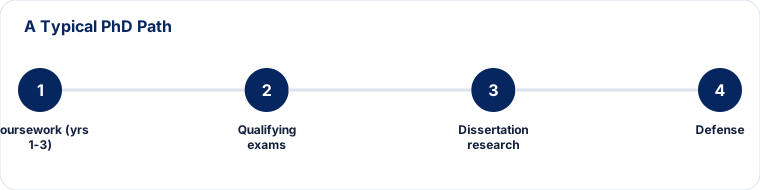
Research doctoral (PhD) programs generally front-load coursework in the first one to three years, followed by comprehensive or qualifying exams, then several years dedicated to original dissertation research conducted under a faculty advisor — the dissertation, not coursework, is what actually determines total time to completion for most PhD students. Professional doctorate programs (MD, JD, PharmD, DDS/DMD, DNP) instead follow a structured, cohort-based curriculum similar in format to a bachelor's or master's program, but longer and denser, typically combining classroom coursework with extensive supervised clinical rotations, externships, or practicum experience in the later years, followed in some fields (medicine, in particular) by a multi-year residency required before independent practice.
Who this credential is for
Students pursuing university faculty or senior research careers (PhD/EdD track); and students entering professions where the doctorate is the standard practicing credential, such as medicine, law, dentistry, and pharmacy (professional doctorate track) — see the specific program pages for fields like medicine, law, dentistry, and pharmacy for how their doctoral pathway works in practice.
Just as importantly, this level is often not the right choice when a shorter or longer credential would serve the same underlying goal more efficiently. Before committing, it's worth asking directly: does my target field actually require this specific level, or a different one, for the role I want? Is there a faster path (a certificate or associate degree) that gets me working sooner in a field where experience counts as much as credential level? Or does my target field's licensure requirement mean a shorter credential simply won't qualify me at all, no matter how strong my resume otherwise looks? The program pages on this site note the typical minimum credential and licensure pathway for each of the 50 fields covered here as a starting reference for this question.
Where this fits on the full degree ladder
| Level | Typical credits | Typical full-time duration |
|---|---|---|
| Certificate | 9-45 credits | A few months to about 1 year |
| Associate | 60-66 credits | About 2 years |
| Bachelor's | 120-128 credits | About 4 years |
| Master's | 30-36+ credits (beyond the bachelor's) | 1-3 years, commonly 2 |
| Doctoral | 30-90 credits plus dissertation/clinical training | 3-7+ years beyond the bachelor's or master's |
Each level generally builds on, rather than replaces, the one before it, and most fields have a recognized minimum level required to practice, with additional levels adding depth, specialization, licensure eligibility, or research capability rather than repeating the same content at greater length. Moving up a level is rarely a matter of simply taking more of the same coursework — it usually means a meaningful jump in specialization, independence expected of the student, and, for licensure-track fields, additional legal scope of practice.
Accreditation considerations
Institutional accreditation matters equally at every credential level — federal financial aid, credit transfer, and general credibility all depend on it regardless of whether you're pursuing a certificate or a doctorate. Programmatic accreditation becomes more consequential the further a field is tied to licensure: a certificate in a non-licensed field (project management, for example) may not have or need a specialized programmatic accreditor, while a doctoral program in medicine, law, dentistry, or pharmacy without the field-specific accreditor (LCME/COCA, ABA, CODA, ACPE respectively) is not a credential that leads to licensure at all, regardless of its academic content. See our accreditation guide for the accreditor that applies to your specific field before enrolling at any credential level. As a practical check, search the Department of Education's accredited-institution database and, where relevant, the field-specific accreditor's own program directory for the exact institution and program name — not just the institution's general reputation — before paying a deposit or signing an enrollment agreement.
Financial aid at this level
PhD funding and professional doctorate funding look very different. PhD students in many fields (particularly sciences, social sciences, and some humanities) are commonly funded through multi-year assistantship packages covering tuition plus a living stipend, sometimes framed as a condition of admission rather than a separate application. Professional doctorate students (MD, JD, PharmD, DDS, DNP) typically do not have equivalent guaranteed funding and rely more heavily on federal Direct Unsubsidized and Grad PLUS Loans, institutional scholarships, and personal resources — total borrowing in these fields can be substantial, which is worth weighing explicitly against expected post-licensure income (see our careers page for how to do that comparison).
Common mistakes at this level
- Confusing a PhD program (research-focused, often funded) with a professional doctorate (practice-focused, typically self-funded) when researching a field.
- Underestimating total time to completion for a PhD, where the dissertation phase — not coursework — is the primary driver of how long the degree actually takes.
- Not confirming programmatic accreditation (LCME/COCA for medicine, ABA for law, CODA for dentistry, ACPE for pharmacy) before enrolling in a professional doctorate, since a degree from an unaccredited program in these fields will not lead to licensure.
How this looks across different fields
The same credential level plays a different role from field to field. In fields like nursing, an associate degree (ADN) is a genuine, licensable entry point into practice as a registered nurse, while in a field like software engineering, an associate degree is far less commonly the terminal credential employers expect. In fields like medicine, law, dentistry, and pharmacy, the doctoral level is not an optional advanced credential — it is the entry-level practicing credential, with no bachelor's-only path to licensure. In fields like accounting, a bachelor's degree covers the core content, but many states require 150 total credit hours (beyond the standard 120) for CPA licensure, which some students satisfy with a bachelor's-plus-extra-coursework path and others satisfy with a full master's degree. Check each of the 50 program pages on this site for the field-specific licensure and accreditation notes relevant to the doctoral degree level in that field, since assuming a general rule about credential levels applies uniformly across every field is one of the most common planning mistakes prospective students make.
A realistic example
Consider two different students both described as "pursuing a doctorate." One is a biology bachelor's graduate admitted into a fully funded PhD program, receiving a tuition waiver and a stipend in exchange for research and teaching work over an expected five to six years, aiming for a research career. The other is a bachelor's graduate admitted into a four-year, self-funded Doctor of Pharmacy (PharmD) program, taking out loans to cover tuition, with a clear, structured curriculum leading to NAPLEX licensure and practice as a pharmacist. Both are "doctoral students," but their funding, timeline, and end goal are almost entirely different — a distinction worth understanding clearly before assuming general doctoral advice applies equally to both situations.
What comes after a doctoral degree
A doctoral degree is generally the terminal credential in a field — the highest level of formal education recognized, whether that means a PhD graduate moving into a faculty research career or a professional doctorate graduate (MD, JD, PharmD, DDS, DNP) entering licensed practice, often followed by field-specific post-degree requirements like a medical residency or a bar exam rather than further formal schooling. Continuing education after a doctorate typically takes the form of licensure renewal requirements, board certifications in a subspecialty, or postdoctoral research positions (common in PhD fields) rather than another degree level.
Frequently asked questions
How is a PhD different from a professional doctorate like an MD or JD?
A PhD is built around producing original research culminating in a dissertation, aimed primarily at research and academic careers. A professional doctorate (MD, JD, PharmD, DDS/DMD, DNP) is the standard entry-level practicing credential for a licensed profession, built around structured coursework and supervised clinical or practical training rather than original research.
Do all doctoral students pay full tuition?
PhD students in many fields, particularly in the sciences and social sciences, commonly receive full or partial tuition waivers plus a stipend through teaching or research assistantships. Professional doctorate students (MD, JD, PharmD, DDS, DNP) typically do not have equivalent assistantship funding and more often self-fund through loans and savings.
How long does a doctoral degree really take?
It varies enormously by type: professional doctorates generally run 3-4 years of structured coursework and clinical training (plus residency for MDs); PhDs vary more widely, commonly 4-7 years depending on the field, the dissertation topic, and funding availability.
Can I stop after a master's if I start a PhD program and change my mind?
Some PhD programs award a master's degree along the way (sometimes automatically after passing qualifying exams, sometimes requiring a separate application), which can serve as a credentialed stopping point; policies vary by program, so ask directly about this option before enrolling if it matters to your risk tolerance.
Do I need a master's degree before starting a doctoral program?
It depends on the field and program — some PhD programs admit directly from a bachelor's degree (common in the sciences), integrating master's-level coursework into the early years of the PhD; professional doctorates (MD, JD, PharmD, DDS, DNP) generally admit from a bachelor's degree directly, without a required separate master's first.
What's the actual difference between a PhD and an EdD?
Both are research doctorates; a PhD in education is traditionally more research-methodology-focused and academia-oriented, while an EdD is traditionally more practice-oriented, aimed at educational leadership and administration roles — though the distinction has blurred at some institutions, so compare specific program curricula directly.
For how this credential level fits your specific field of interest, see the relevant program page, which notes typical entry-level requirements, accreditation, and career data for that field specifically.
