
Overview
This page maps out how to research Education programs specifically in Illinois: state financial aid, Illinois's public university options, and where the field's licensure or certification requirements (if any) route through a Illinois-specific board, layered on top of the national curriculum, accreditation, and BLS-sourced career framework covered on our national Education programs page.
As a Midwest-region state, Illinois's higher-education landscape reflects some regional patterns worth knowing before you start comparing specific schools — see the regional note above. Springfield is the state capital, and Chicago is the state's largest city.
Why research a field at the state level at all, beyond the national framework? Two reasons in practice: financial aid, since state grant programs like Illinois's Monetary Award Program (MAP) are only available to residents (or, in some cases, students enrolled at an in-state institution) and are worth checking before you assume federal aid alone will cover your cost; and, for licensed fields, the specific state licensing board whose current requirements a program actually needs to satisfy for you to sit for the licensing exam after graduating. Neither of those two factors changes the underlying curriculum or national accreditation framework — those apply the same way regardless of state — but both can materially change your total cost and, in licensed fields, whether a specific program is even a viable option for practicing in Illinois specifically.

Friendly editorial photography gives long research pages a natural visual pause while the detailed data, sources, tables, and guidance stay central.
Education photo via UnsplashTypical curriculum
Curriculum for education programs is set at the institution level, not the state level, so the core coursework below applies to education programs in Illinois the same way it applies nationally:
- Educational Psychology
- Curriculum and Instruction
- Classroom Management
- Assessment and Evaluation
- Special Education Foundations
- Literacy Instruction
- Student Teaching / Clinical Practice
- Educational Technology
Compare this list against the actual course catalog of any specific Illinois school you're considering — course titles vary by institution even when underlying content is similar, so read course descriptions rather than relying on titles alone. Elective and concentration options built around this core coursework are where individual Illinois programs most often differentiate themselves from one another and from similarly-titled programs in other states, so ask what specializations or elective tracks a specific school actually offers within the field.
Accreditation to verify
For education specifically, the field's primary programmatic accreditor to check is Council for the Accreditation of Educator Preparation (CAEP) or the Association for Advancing Quality in Educator Preparation (AAQEP); state boards of education for licensure. This applies the same way to Illinois-based programs as anywhere else — programmatic accreditation is granted by national or field-specific accrediting bodies, not by the state itself. A short, repeatable verification process:
- Search the accreditor's own program directory for the specific institution and program name.
- Cross-check the institution's overall accreditation status in the U.S. Department of Education's Database of Accredited Postsecondary Institutions and Programs (ope.ed.gov/dapip).
- Ask the program directly for its current accreditation status in writing if you can't find it published, and be wary if a program is vague or evasive about naming its accreditor.
- Recheck accreditation status close to enrollment, since status can change between when you first research a program and when you actually enroll.
See our full accreditation guide for how institutional and programmatic accreditation work together, and our Illinois overview page for state-specific institutional context.
Career outlook
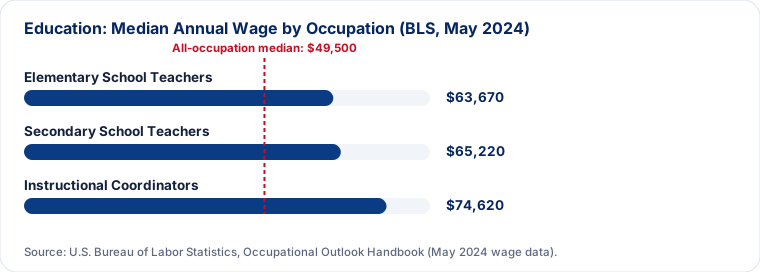
Education graduates commonly pursue roles including the following, with wage and outlook data from the BLS Occupational Outlook Handbook (May 2024 wages; 2024-34 projections), compared against the $49,500 national median wage for all U.S. occupations:
| Related occupation (BLS) | Median annual wage (May 2024) | Job outlook (2024-34) |
|---|---|---|
| Elementary School Teachers | $63,670 | slower than the average for all occupations (1% projected growth, 2024-34) |
| Secondary School Teachers | $65,220 | slower than the average for all occupations (1% projected growth, 2024-34) |
| Instructional Coordinators | $74,620 | slower than the average for all occupations (2% projected growth, 2024-34) |
Explore education across a> / Education
Use this statewide map for geographic context while comparing colleges, degree programs, and education options in Education.
This is a statewide research map, not a campus-location claim. Individual institution locations should be confirmed directly with the institution.
These are national figures, not Illinois-specific ones — actual pay in Illinois may run above or below the national figures shown, depending on the specific metro area, cost of living, and local demand. For Illinois-specific and metro-level wage data, use the BLS Occupational Employment and Wage Statistics (OEWS) program, which publishes state- and metro-level figures separately from the national numbers shown here; see our careers page for how to look that up.
Licensure & certification in Illinois
Licensure/certification pathway: State teaching license or certification, typically requiring a CAEP/AAQEP-aligned preparation program, supervised clinical practice, and a state licensure exam (e.g., Praxis).
Where this field requires state licensure, the specific licensing board is a Illinois state agency separate from the Illinois Student Assistance Commission (which handles financial aid, not licensing) — search for "Illinois [profession] licensing board" to find the correct agency, and confirm directly with that board that a specific program's graduates are eligible to sit for the relevant licensing exam in Illinois, since eligibility rules can vary slightly by state even within an accredited field.
Where to study Education in Illinois
Among Illinois's public higher-education options, University of Illinois Urbana-Champaign and Illinois State University are generally the most recognized starting points, though many students find a better fit at a smaller regional public university, a community college, or a private institution once they compare actual program offerings, cost, and format against their specific goals. Education centers licensure at the bachelor's degree (or, for career-changers, an alternative certification pathway), since a state teaching license — not the degree alone — is what legally authorizes classroom teaching. A master's degree commonly supports advanced licensure endorsements, instructional specialties, or administrative credentials. Certificate-level pages in this field typically describe alternative certification or endorsement programs rather than initial licensure, and a doctoral degree (EdD or PhD) supports educational leadership, policy, or research careers.
Beyond the major public options named above, Illinois likely has additional public regional universities, community colleges, and private institutions offering education at one or more degree levels — this page names the state's most recognized public options as a starting reference, not an exhaustive list, so treat it as a first step in your research rather than the final word on where education is available in Illinois.
Browse Education by degree level in Illinois
State-specific, level-by-level pages for this field are not yet published for Illinois; see the national level-by-level breakdown instead:
Financial aid in Illinois
Illinois's primary state financial aid program is the Monetary Award Program (MAP), run through the Illinois Student Assistance Commission. This is separate from federal aid (FAFSA, Pell Grants, federal loans — see our financial aid guide) and typically requires its own application steps and deadlines, which the Illinois Student Assistance Commission publishes and updates; always confirm current eligibility and award figures directly with that agency rather than assuming a prior year's numbers still apply.
Total cost for a Education program depends far more on the specific institution and your residency status than on the field itself, but the same financial aid mechanics apply across every field on this site: the FAFSA determines eligibility for federal grants, loans, and work-study; institutional and state aid layer on top; and net price (not published tuition) is the number that actually matters for comparison. See our full financial aid guide for current federal figures, and our degree-level pages for typical credit-hour and cost ranges at each level. Where Education has field-specific cost drivers — required lab fees, clinical supervision costs, licensing exam fees, or extended clinical/residency training — those are noted in the licensure section above.
Format: online vs. on campus
Many Education programs are now available online, in a hybrid format, or fully in person, and format flexibility has become one of the more consequential ways individual programs differ from one another. Fully online programs tend to suit working adults and students managing family or geographic constraints; in-person programs offer more direct access to labs, studios, or clinical facilities where the field requires them; hybrid formats attempt to combine both. Fields like this one that involve required clinical rotations, practicums, residencies, or supervised fieldwork cannot be completed fully online regardless of format marketing, since that hands-on component is generally non-negotiable for accreditation and licensure — and any required in-person component would need to be completed at a site in or near Illinois if you're attending an out-of-state online program. Whichever format you're considering, confirm institutional accreditation applies equally to the online version of the program (it generally does, since accreditation applies to the institution and program rather than the delivery method) and, if you live in a different state than the institution, confirm the program is authorized to enroll students from your state — see our locations guide for how state authorization (NC-SARA) works.
How to evaluate a specific program in Illinois
- Confirm institutional and programmatic accreditation directly, using the steps above.
- Compare the actual course list against the core coursework above.
- If this field requires state licensure, confirm program eligibility directly with Illinois's licensing board for the profession.
- Get a personalized net price using the school's net price calculator, and check eligibility for the Monetary Award Program (MAP) through the Illinois Student Assistance Commission.
- Use our comparison framework to weigh finalists side by side across accreditation, cost, curriculum, outcomes, and support.
See our Illinois overview page for more on residency requirements, public university options, and state-specific accreditation and aid context, or return to the national Education programs page for the complete field-wide picture.
Frequently asked questions
Do I have to attend a Illinois-based school to work in education in Illinois?
Generally no, as long as your program is properly accredited and, where relevant, you meet Illinois's specific licensing requirements — many licensed professionals practice in a state different from where they earned their degree. Confirm license portability and any state-specific exam or supervised-hours requirements directly with Illinois's licensing board for the profession.
Is education available at Illinois's public universities?
Many public university systems offer a wide range of fields, but not every specific program is offered at every campus. Confirm directly with University of Illinois Urbana-Champaign and Illinois State University or the specific institution you're considering, and compare against community college and private options as well.
How do I pay for a education program in Illinois?
Combine federal aid (FAFSA, Pell Grants, federal loans) with Illinois-specific aid through the Monetary Award Program (MAP), plus any institutional aid a specific school offers. See our financial aid guide and the Illinois Student Assistance Commission for current details.
Does this page name specific Illinois colleges to attend?
It names Illinois's major public university options as a starting reference point, not a ranked or exhaustive list. Use the accreditation, curriculum, and licensure framework above to evaluate whichever specific schools you're actually considering, including ones not named on this page.
Is the wage data on this page specific to Illinois?
No — it reflects national BLS figures. Use the BLS OEWS program for Illinois- and metro-specific wage data, referenced in the careers section above.
How is this page different from the national education programs page?
The national page covers curriculum, accreditation, licensure structure, and BLS career data that apply the same way regardless of where you attend school. This page layers Illinois-specific facts on top: the Monetary Award Program (MAP), the Illinois Student Assistance Commission, Illinois's major public institutions, and (where relevant) the specific state licensing board for this field. Use the national page first if you want the complete field-wide picture, then this page for the practical, state-specific details of actually enrolling and, in licensed fields, practicing in Illinois.