

Overview
Here's what's specific to Montana when researching Master's Degree programs: where this level is typically earned in Montana, state-specific financial aid, and typical admission requirements — layered on top of the national master's degree framework covered on our national master's degree guide. A master's degree is an advanced credential built on top of a bachelor's degree, either deepening expertise in the same field (an MS in Computer Science after a CS bachelor's) or adding a professional credential in a new direction (an MBA after an undergraduate degree in an unrelated field). Some fields require a master's degree for licensure or independent practice — nurse practitioners, licensed clinical social workers, and many school counselors, for example — while in other fields it is optional and primarily useful for advancement or specialization.
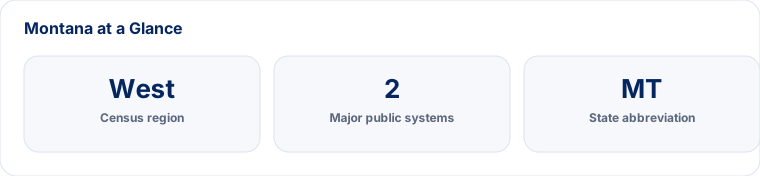
Montana is part of the U.S. Census Bureau's West region — a region with wide variation in higher-education infrastructure, from large multi-campus public systems in more populous states to smaller, more geographically dispersed systems in less populous ones. The state's capital is Helena, and Billings is its largest city, which is often (though not always) where the state's largest concentration of higher-education options is located.
Graduates seeking a licensure-required credential their field mandates beyond the bachelor's; professionals seeking a specific specialization or management-track credential; and students pursuing academic or research careers on the way to a doctoral program. None of that changes based on which state you're in — but two things do: whether Montana's state financial aid program actually covers this specific level (some state grant programs are restricted to certain degree levels), and, practically, which specific Montana institutions offer this level in the field you're actually interested in. This page covers the first; our programs index and the field-specific state pages linked below help with the second.

Friendly editorial photography gives long research pages a natural visual pause while the detailed data, sources, tables, and guidance stay central.
Education photo via UnsplashWhere to earn a master's degree in Montana
In Montana, a master's degree is most commonly earned through graduate schools within universities — both public flagships and private institutions commonly offer master's-level programs. Among Montana's public higher-education options, University of Montana and Montana State University are generally the most recognized starting points, though many students find a better fit at a smaller regional public university, a community college, or a private institution once they compare actual program offerings, cost, and format against their specific goals. As with any state, the specific mix of institutions offering a given field at this level varies — a smaller or more rural state may concentrate certain advanced-level programs (doctoral study in particular) at just one or two institutions, while more populous states typically offer a wider spread of options across more campuses.
Typical admission requirements
A completed bachelor's degree (often, though not always, in a related field), a minimum undergraduate GPA (commonly around a 3.0, though this varies significantly by program), letters of recommendation, a statement of purpose, and sometimes standardized test scores (GRE or GMAT, program-dependent) or relevant professional work experience, particularly for professional master's programs.
These are general norms across institutions and are not specific to Montana — admission requirements are set at the institution level, not the state level, so always confirm current requirements directly with the admissions office of any specific Montana school you're considering. Selective programs within a field (nursing and engineering programs in particular, at the levels where those fields have competitive secondary admission) can have meaningfully higher requirements than a school's general admission standards, even at otherwise less selective institutions.
Cost & time to complete
A master's degree typically requires 30-36 credits (some professional master's programs, including many MBA and nursing programs, require up to 50) and takes 1-3 years of full-time study, most commonly about 2 years. On cost: Highly variable by field and institution type; public in-state graduate tuition is generally lower than private, and many students fund graduate study in part through assistantships (common in research-focused fields) that include a tuition waiver and stipend.
Total cost for a master's degree program depends far more on the specific institution and your residency status than on the field itself, but the same financial aid mechanics apply across every field on this site: the FAFSA determines eligibility for federal grants, loans, and work-study; institutional and state aid layer on top; and net price (not published tuition) is the number that actually matters for comparison. See our full financial aid guide for current federal figures, and our degree-level pages for typical credit-hour and cost ranges at each level. Where master's degree has field-specific cost drivers — required lab fees, clinical supervision costs, licensing exam fees, or extended clinical/residency training — those are noted in the licensure section above.
In-state residents attending public institutions in Montana generally see the lowest published tuition among these options, since public institutions set separate, lower tuition rates for state residents specifically. Out-of-state and private-institution costs are typically higher before aid, though a strong institutional aid package can sometimes narrow or even eliminate that gap on a net-price basis — which is exactly why comparing net price, not published tuition, matters more than which category of institution looks cheapest on paper.
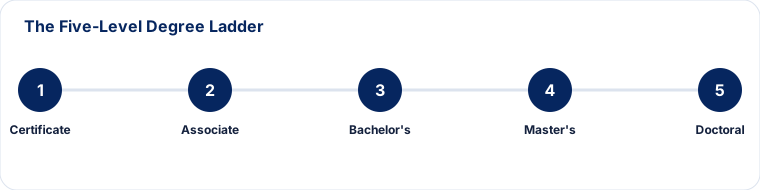
Curious how this level stacks up? Here's how it compares to the other four in typical credits and duration:
| Level | Typical credits | Typical duration |
|---|---|---|
| Certificate | 9-45 credits | A few months to about 1 year |
| Associate Degree | 60-66 credits | About 2 years |
| Bachelor's Degree | 120-128 credits | About 4 years |
| Master's Degree | 30-36+ credits beyond the bachelor's | 1-3 years, commonly 2 |
| Doctoral Degree | 30-90 credits plus dissertation/clinical training | 3-7+ years beyond the bachelor's or master's |
Explore education across a> / Master's Degree
Use this statewide map for geographic context while comparing colleges, degree programs, and education options in Master's Degree.
This is a statewide research map, not a campus-location claim. Individual institution locations should be confirmed directly with the institution.
Financial aid in Montana
Beyond federal aid (the FAFSA, Pell Grants, and federal student loans, described in our financial aid guide), Montana residents can apply for state-specific aid through the Montana University System Honor Scholarship, administered by the Montana University System / OCHE. Eligibility rules, award amounts, and deadlines for state aid programs like this one change from year to year and often have separate deadlines from the FAFSA itself, so confirm current details directly with the Montana University System / OCHE rather than relying on any third-party summary, including this one.
Career outlook at this level
At the master's level, expect access to more specialized, senior, or management-track versions of the roles below, generally with higher earning potential than bachelor's-level entry, though a master's degree is not required for every role listed and its value depends heavily on the specific role and employer. Career outcomes at the master's degree level vary enormously by field — see our programs index or the field-specific pages linked below for occupation- and wage-specific data from the BLS, since a single, field-agnostic wage figure for "master's degree holders in Montana" would obscure more than it reveals.
A more useful way to think about career outlook at this level is to ask two separate questions rather than one combined one: first, does the field you're interested in treat this specific level as a genuine entry point, an optional add-on, or pre-professional preparation for a further credential (the "How the degree ladder works" section on each field's national program page answers this directly); and second, what do the specific BLS-sourced occupation and wage figures for that field look like, regardless of level. Answering both, field by field, produces a far more accurate picture than any single generalized statement about this degree level could — which is exactly why this site organizes career data by field first rather than trying to summarize outcomes for "master's degree holders" as an undifferentiated group.
Browse fields at the master's degree level in Montana
Browse all fields available in Montana (each linked page covers every degree level, including master's degree):
Format: online vs. on campus
Many master's degree programs are now available online, in a hybrid format, or fully in person, and format flexibility has become one of the more consequential ways individual programs differ from one another. Fully online programs tend to suit working adults and students managing family or geographic constraints; in-person programs offer more direct access to labs, studios, or clinical facilities where the field requires them; hybrid formats attempt to combine both. Whether a specific program at this level can be completed fully online depends heavily on the field rather than the degree level itself — fields with required clinical rotations, practicums, or supervised fieldwork generally cannot be completed fully online regardless of format marketing, while many others can. Whichever format you're considering, confirm institutional accreditation applies equally to the online version of the program (it generally does, since accreditation applies to the institution and program rather than the delivery method) and, if you live in a different state than the institution, confirm the program is authorized to enroll students from your state — see our locations guide for how state authorization (NC-SARA) works.
How to evaluate a specific master's degree program in Montana
- Confirm institutional and (where relevant to your field) programmatic accreditation directly — see our accreditation guide.
- Confirm the admission requirements above against the specific program's current published requirements.
- Get a personalized net price using the school's net price calculator, and check eligibility for the Montana University System Honor Scholarship through the Montana University System / OCHE.
- Compare the specific field's curriculum and career outcomes using our programs index.
- Use our comparison framework to weigh finalists side by side.
See our Montana overview page for more on residency requirements and public university options, or the national master's degree guide for the complete picture across every field.
Frequently asked questions
Is a master's degree from a Montana school treated differently than one from another state?
Generally no, as long as the institution is properly accredited — accreditation, not the state where a school is located, is what employers, licensing boards, and other institutions generally rely on to evaluate a degree's legitimacy.
How much does a master's degree cost in Montana?
Highly variable by field and institution type; public in-state graduate tuition is generally lower than private, and many students fund graduate study in part through assistantships (common in research-focused fields) that include a tuition waiver and stipend Montana-resident students at public institutions generally pay lower published tuition than out-of-state students; always confirm net price directly with a specific school.
Can I complete a master's degree in Montana while working full-time?
Often yes, particularly at institutions offering evening, weekend, or online formats, though full-time work can extend the typical completion timeline above. Confirm a specific program's format flexibility directly, since this varies significantly by institution and field.
What comes after a master's degree in Montana?
See the national Doctoral Degree guide for the next rung up, where applicable to your goals.
Does Montana's state aid cover a master's degree?
Check directly with the Montana University System / OCHE — many state grant programs cover multiple degree levels, but eligibility and award amounts can vary by level and by program type.
How is this page different from the national master's degree guide?
The national guide (linked throughout this page) covers what a master's degree means, typical curriculum depth, and career framing that apply regardless of location. This page layers Montana-specific facts on top: where this level is typically earned in-state, Montana's public institutions, and the Montana University System Honor Scholarship through the Montana University System / OCHE. Use the national guide first for the complete picture, then this page for the practical details of pursuing this level specifically in Montana.
